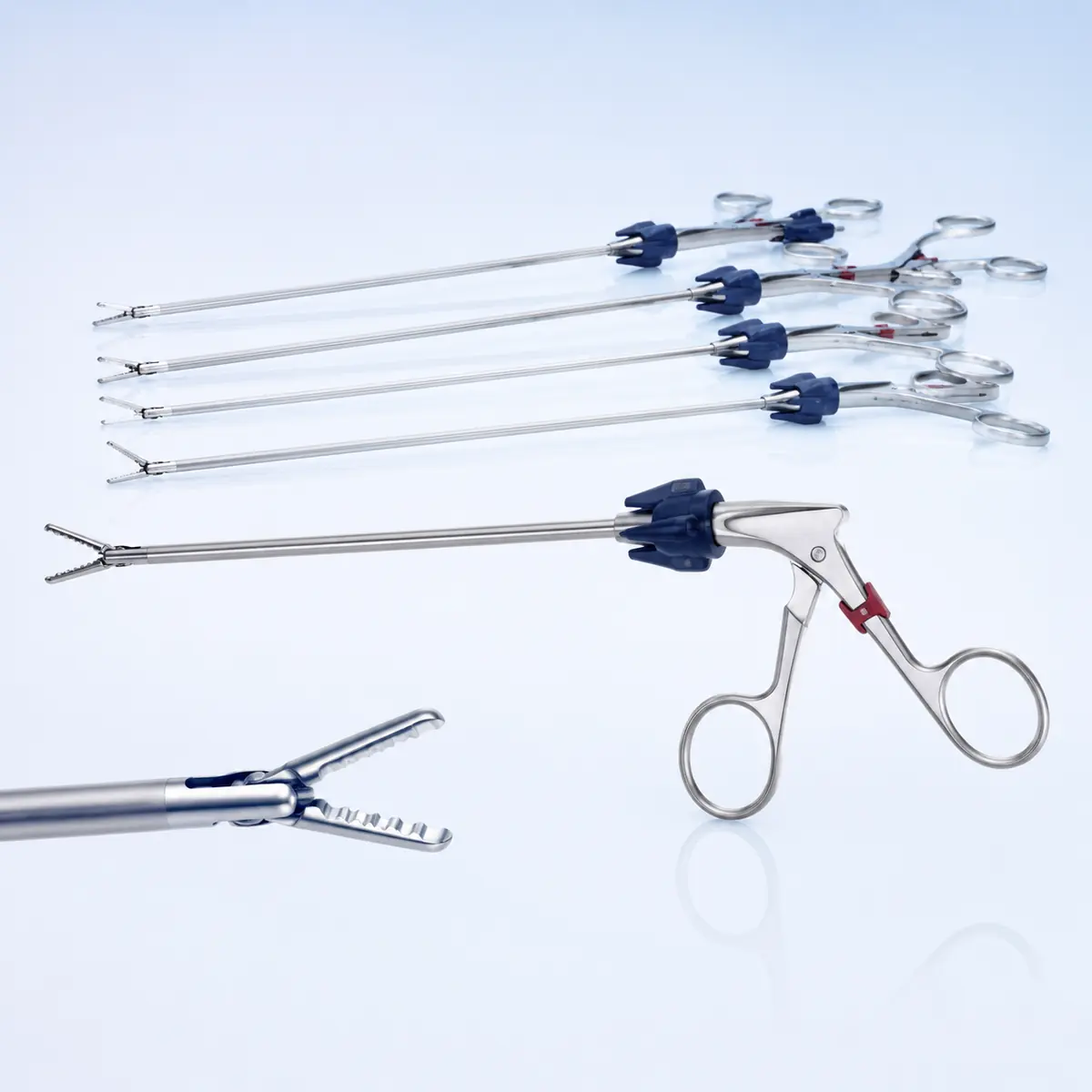
Bharat Surgical manufactures and supplies reusable laparoscopic instruments for hospitals, surgical centres, gynaecology departments, dealers and distributors. Laparoscopic tenaculum forceps can be configured with toothed or claw-type jaws for firm tissue holding and manipulation during approved minimally invasive procedures. Buyers should specify the required jaw pattern, shaft diameter, working length, handle design, locking mechanism and rotation. Tenaculum forceps should not be ordered only by product name because tip geometry and tissue-holding characteristics vary significantly between models.
Laparoscopic tenaculum forceps are intended for use by qualified healthcare professionals. Product information does not replace surgical training, clinical judgement or the product instructions for use.
A dedicated laparoscopic tenaculum forceps listing was not found in Bharat Surgical’s currently published online catalogue. Before this page goes live, Bharat Surgical should confirm:
Until these details are verified, dimensions such as 5 mm × 330 mm should be presented as an enquiry requirement—not as a confirmed Bharat Surgical specification.
A laparoscopic tenaculum forceps is a long-shaft minimally invasive instrument with pointed, toothed or claw-type jaws designed to provide a firm mechanical hold on tissue during an approved surgical procedure.
Its principal components may include:
Designed for deep abdominal and pelvic access.
Pointed tips designed to provide a secure mechanical grip.
Ergonomic choices to match surgeon tactile preference.
Locks the jaws in position for steady continuous retraction.
360-degree rotation knob for precise jaw orientation.
Choice of electrical insulation for electrosurgical safety.
Modular assembly options for cleaning and component replacement.
Unlike an atraumatic grasper, a tenaculum uses penetrating or strongly engaging tips. Its intended tissue, tip pattern and holding mechanism must therefore be clearly specified.
The following configurations are commonly requested in the surgical-instrument market. Bharat Surgical availability must be confirmed before publication or quotation.
| Configuration | Typical buyer requirement | Status |
|---|---|---|
| Single-Tooth Tenaculum | One opposing tooth or hook pattern | Availability to be confirmed |
| Double-Tooth Tenaculum | Multiple-point engagement | Availability to be confirmed |
| Claw-Type Tenaculum | Two- or multi-prong claw jaws | Compare with Bharat claw forceps |
| Vulsellum-Pattern Tenaculum | Interlocking toothed jaws | Availability to be confirmed |
| Straight Tenaculum | Straight shaft and jaw orientation | Availability to be confirmed |
| Curved Tenaculum | Curved distal jaw or tip | Availability to be confirmed |
| Ratcheted Tenaculum | Handle lock maintains jaw closure | Availability to be confirmed |
| Non-Ratcheted Tenaculum | Closure maintained manually | Availability to be confirmed |
| Rotatable Tenaculum | Shaft rotation controlled from the handle | Availability to be confirmed |
| Detachable Tenaculum | Separate handle, shaft and jaw insert | Availability to be confirmed |
| Fixed Tenaculum | Complete non-detachable instrument | Availability to be confirmed |
| Parameter | Required confirmation |
|---|---|
| Product name | Laparoscopic Tenaculum Forceps |
| Catalogue number | To be confirmed |
| Jaw pattern | Single tooth, double tooth, claw or vulsellum |
| Tip orientation | Straight or curved |
| Nominal shaft diameter | To be confirmed |
| Working length | To be confirmed |
| Maximum jaw opening | To be confirmed |
| Tooth or prong dimensions | To be confirmed |
| Handle type | Ring, pistol, axial or other |
| Locking mechanism | Ratchet, lockable or non-locking |
| Rotation | Fixed or rotatable |
| Construction | Fixed or detachable |
| Material | Component-wise specification required |
| Electrosurgical function | Normally non-electrosurgical unless specifically documented |
| Reusability | To be confirmed |
| Sterile supply | To be confirmed |
| Reprocessing method | Product-specific IFU required |
| Compatible trocar | To be confirmed |
A single-tooth pattern generally uses one pointed engagement area on each jaw or an opposing tooth-and-recess arrangement.
Confirm:
A double-tooth pattern uses more than one engagement point. Request a drawing because “double tooth” can describe different jaw arrangements.
Confirm:
A claw-type design has curved, pointed or pronged jaws. Bharat Surgical publishes a separate laparoscopic claw forceps, but it should not automatically be renamed a tenaculum.
The claw-forceps listing identifies:
If this product is intended to serve as Bharat Surgical’s tenaculum configuration, the product name, dimensions and intended use should be formally confirmed.
A vulsellum-pattern instrument usually has interlocking pointed teeth. “Vulsellum” and “tenaculum” are sometimes used loosely in procurement, but they should not be assumed to represent identical jaws.
Request the exact tip photograph and drawing.
| Selection point | Straight | Curved |
|---|---|---|
| Distal orientation | Aligned with the shaft | Angled or curved relative to the shaft |
| Working direction | Direct axial approach | Offset approach |
| Visibility | Depends on jaw and shaft | Curvature may change the line of access |
| Product selection | Based on intended procedure and user preference | Based on intended procedure and user preference |
| Required information | Jaw length and opening | Curve direction, angle and jaw length |
Neither configuration should be described as universally preferable.
| Ratcheted handle | Non-ratcheted handle | |
|---|---|---|
| Can maintain jaw closure through a locking mechanism | Jaw closure is maintained manually | |
| Requires inspection of ratchet teeth | Fewer locking components | |
| Lock strength and release must be checked | Handle spring and movement must be checked | |
| May be selected when maintained closure is required | May be selected for continuous manual control |
The number of ratchet positions and release mechanism should be included in the product specification.
Possible configurations include:
For each handle, confirm:
| Fixed instrument | Detachable instrument | |
|---|---|---|
| Handle, shaft and jaws remain assembled | Handle, shaft and insert may separate | |
| Fewer assembly steps | Components can be cleaned separately if permitted | |
| Complete instrument replaced or repaired as one unit | Components require compatibility confirmation | |
| Inspect full instrument | Inspect every component and connection | |
| One catalogue number may identify the complete unit | Multiple component codes may be required |
Detachable components from different manufacturers should not be mixed without documented compatibility.
| Point | Tenaculum forceps | Myoma screw |
|---|---|---|
| Working end | Opposing toothed or claw jaws | Single or multi-point threaded screw |
| Actuation | Handle opens and closes jaws | Rotational screw engagement |
| Holding method | Jaw closure | Threaded engagement |
| Published Bharat product | Dedicated model requires confirmation | 5 mm × 330 mm myoma screw is published |
| Procurement focus | Tooth pattern, jaw opening and ratchet | Thread pattern, point count and handle |
The two instruments should not be treated as interchangeable solely because both are used for firm tissue holding.
| Point | Tenaculum forceps | Claw forceps |
|---|---|---|
| Product description | Toothed holding forceps | Claw or multi-prong grasping forceps |
| Jaw profile | Single, double or interlocking teeth | Curved claw-shaped jaws |
| Locking | Ratchet may be provided | Depends on handle design |
| Published Bharat data | Dedicated specification pending | 10 mm, 180 mm ring-handle listing |
| Selection | Exact tooth geometry | Claw geometry and jaw opening |
A claw forceps may perform a related holding function, but its approved name and intended use should be retained.
| Tenaculum | Atraumatic grasper | |
|---|---|---|
| Pointed or toothed working end | Broader, non-penetrating jaw pattern | |
| Intended for firm engagement | Intended for lower-penetration holding | |
| Tooth dimensions are critical | Serration and fenestration are critical | |
| May create concentrated contact points | Distributes contact over a larger surface | |
| Selected for different handling requirements | Selected for different handling requirements |
The choice must be made by the responsible clinical team according to the intended procedure.
The terms may overlap in some catalogues, but the instruments can differ in:
Use a photograph, drawing and catalogue code rather than relying only on terminology.
Common RFQs may request a 5 mm laparoscopic shaft, but Bharat Surgical’s exact tenaculum diameter must be confirmed.
Before ordering, verify:
A nominal 5 mm instrument may not pass through every trocar labelled 5 mm.
The working length affects reach and handle position. Buyers commonly request approximately 330 mm for standard laparoscopic instruments, but this value is not verified for the Bharat Surgical tenaculum.
The datasheet should distinguish:
A standard laparoscopic tenaculum is generally a mechanical, non-electrosurgical instrument. It should not be connected to an electrosurgical generator unless the exact model is specifically designed, insulated and validated for that function.
The quotation should clearly state:
Do not infer energy compatibility from a black insulated-looking handle.
A tenaculum with bent, misaligned or damaged teeth should be removed from service.
Reusable tenaculum forceps must be reprocessed according to the validated model-specific IFU.
The process may include:
Extra attention should be given to interlocking teeth, hinges and ratchet surfaces where residue can remain.
Service evaluation may include:
Repair should restore the approved jaw geometry and locking force without altering the tip dimensions.
Include:
Dealers may request:
"Reusable Laparoscopic Tenaculum Forceps, [single-tooth/double-tooth/claw/vulsellum] jaw pattern, [straight/curved] tip, nominal [shaft diameter], approximately [working length], [ring/pistol/axial] handle with [ratcheted/non-ratcheted] closure and [fixed/rotatable] shaft. Stainless-steel working components, suitable for a compatible [trocar size] port. Supplier to confirm maximum jaw opening, tooth dimensions, sterile-supply condition and validated reprocessing instructions."
Subject to final tenaculum-model verification:
Do not publish specific tenaculum models or dimensions until Bharat Surgical approves the final product data.
Find technical, reprocessing, ordering, and size compatibility answers for the Bharat Surgical Tenaculum Forceps range.
It is a long-shaft laparoscopic instrument with toothed or claw-type jaws designed for firm tissue holding during an approved procedure.
A dedicated online product listing could not be verified. The exact model and specifications must be confirmed before publication.
Possible requirements include single-tooth, double-tooth, claw and vulsellum patterns. Bharat Surgical availability requires confirmation.
It uses a single principal tooth or hook arrangement at the opposing jaws.
It uses multiple tooth-engagement points. Exact geometry differs between models.
It uses curved, pointed or multi-prong jaws for firm mechanical engagement.
Not necessarily. The names may describe related but different jaw patterns and approved uses.
The terms sometimes overlap, but tooth number, jaw shape, length and intended use may differ.
No. A tenaculum uses closing jaws, while a myoma screw uses a threaded working end.
No. A tenaculum uses pointed or strongly engaging jaws; an atraumatic grasper uses a broader, lower-penetration jaw profile.
A 5 mm configuration may be requested, but Bharat Surgical’s exact model must be confirmed.
The dedicated tenaculum working length is not published. State the required length in the enquiry.
Approximately 330 mm is commonly requested for laparoscopic instruments, but it is not yet a verified Bharat tenaculum specification.
These are common procurement options, subject to Bharat Surgical’s confirmed range.
A ring handle may be requested. The approved handle options must be confirmed.
Ratcheted configurations may be requested, subject to model availability.
It maintains the selected jaw-closure position through a mechanical locking system.
It may be available on request, but it requires confirmation.
Rotation is model-dependent. Specify whether a fixed or rotatable instrument is required.
Fixed and detachable configurations may be possible. Obtain the exact component list before ordering.
No compatibility should be assumed. Handle, sheath and insert must belong to an approved system.
A standard model is generally mechanical and non-electrosurgical unless specifically designed and documented otherwise.
Only if the exact model is designed and validated for electrosurgical use.
No. The trocar channel, valve, seal, instrument shaft and closed-jaw profile must be compatible.
Reusable construction is expected for this page, but it must be confirmed for the approved Bharat model.
Use only the sterilisation cycle stated in the approved product-specific IFU.
Sterile or non-sterile supply must be stated in the quotation.
Check for missing, bent, blunt, cracked or misaligned teeth and confirm full jaw closure.
Check engagement, holding, controlled release, wear and alignment.
Follow the model-specific IFU, paying attention to teeth, jaw recesses, hinges and ratchet surfaces.
The instrument should be evaluated through an approved service process. Uncontrolled reshaping may damage the jaws.
Custom configurations may be discussed subject to feasibility, quantity, validation and regulatory requirements.
Sample evaluation may be discussed after the exact model is confirmed.
Yes, subject to approved configuration, quantity, packaging and destination documentation.
Provide the jaw pattern, shaft diameter, length, handle, ratchet, rotation, quantity and delivery destination.
Price depends on: For an accurate quotation, send the required jaw image or drawing with the desired shaft diameter, length and quantity.
Factors Affecting Price: Jaw pattern, Tooth or prong configuration, Shaft diameter, Working length, Handle design, Ratchet mechanism, Rotation, Fixed or detachable construction, Material and surface finish, Sterile-supply status, Quantity, Packaging, Export documentation, Delivery destination