Bharat Surgical Co. accepts enquiries for selected arthroscopy instruments and sheath requirements for compatible systems. Established in 1975 and based in Mumbai, India, the company supports hospitals, orthopaedic departments, surgeons, biomedical teams, procurement departments, dealers, distributors and international buyers subject to exact product, compatibility, documentation and supply confirmation.
For an accurate quotation, share the required instrument or sheath, intended system, telescope make and model, interface photographs, diameter and working length, locking and port arrangement, obturator and accessory requirements, reusable or other status, processing documents, quantity, destination and required date. Bharat Surgical will confirm the proposed item, accepted compatibility basis, supplied set, evidence, price and delivery in writing.
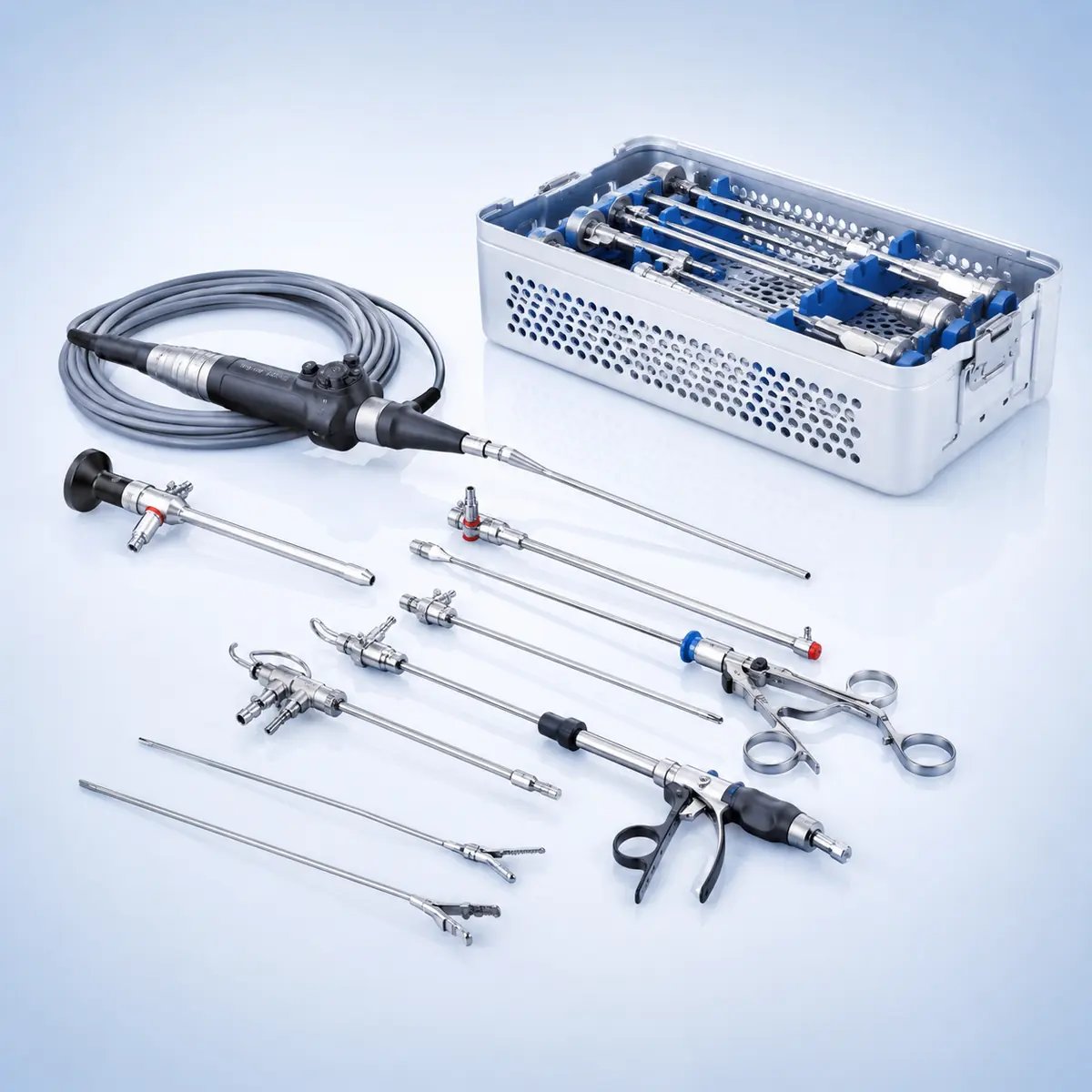
Arthroscopy instruments are devices used with a compatible arthroscope and related visualization, access and fluid-management components for minimally invasive examination or treatment inside a joint. A complete setup may involve a telescope, sheath or cannula, obturator, ports, valves, camera connection, light transmission, tubing and procedure-specific hand instruments. The exact approved system depends on the intended use and manufacturer documentation.
The word 'arthroscopy' identifies a clinical field, not a universal connection standard. Two components may look similar and still differ in outside diameter, working length, telescope fit, locking geometry, optical orientation, seal design, stopcock thread or fluid-path performance. Buyers should approve the complete combination instead of ordering from a generic name such as 'Storz type' or 'universal sheath.'
Build this as a product-family hub, keeping product-specific specifications on the relevant child URL.
Use this route for a sheath assembly only after confirming telescope interface, sheath diameter and working length, locking mechanism, obturator, inflow/outflow ports, stopcocks, valves, seals, and processing instructions.
Read MoreUse this checklist for every line item to prevent generic terms from being mistaken for technical specs.
| Selection Field | Information to Confirm |
|---|---|
| Product Identity | Legal manufacturer, brand, exact product name, catalogue or reference number, revision, current status, intended use, supplied condition and country of origin. |
| System Identity | Arthroscope/telescope, camera, light cable and any fluid-management equipment make, model, reference number and approved combination relevant to the quoted item. |
| Telescope Interface | Telescope outside diameter, working length, viewing direction where relevant, eyepiece/coupling arrangement and exact sheath locking interface. |
| Sheath Geometry | Outside/inside diameter, working and overall length, distal profile, wall thickness where controlled, tolerances, markings and dimensional drawing. |
| Ports and Fluid Path | Number and purpose of ports, inflow/outflow arrangement, stopcock orientation, connector type, valve or seal design, tubing connection, flow/leak evidence and disassembly. |
| Included Components | Sheath body, obturator, trocar or blunt insert where applicable, stopcocks, valves, seals, caps, adapters, brushes, protection tube and quantities. |
| Material and Finish | Exact material specification by component, heat treatment where relevant, surface finish, passivation or other treatment, corrosion controls and evidence. |
| Reusable and Supplied Status | Reusable/single-use status, sterile/non-sterile supplied condition, packaging, shelf life where applicable, maximum-use or inspection limits and disposal information. |
| Processing Information | Point-of-use treatment, disassembly, cleaning, flushing, brushing, disinfection, drying, inspection, lubrication, packaging, sterilization, storage and transportation instructions for the exact item. |
| Performance and Inspection | Lock security, telescope retention, seal function, stopcock/valve operation, lumen patency, finish, alignment and model-defined acceptance criteria. |
| Evidence and Traceability | Datasheet, drawing, labels, IFU, material or inspection records, applicable standards/editions, registration, lot/serial marking, warranty and service information. |
| Commercial Supply | Quantity, MOQ, sample or demo policy, customization, inspection, packing, freight, delivery, warranty, replacement parts and quotation validity. |
Do not rely on look-alike designs. Verify compliance and dimensions across all connecting points.
| Interface Boundary | Required Verification |
|---|---|
| Telescope to Sheath | Confirm outside diameter, working length, lock type, orientation, clearances and exact approved reference combination. |
| Obturator to Sheath | Confirm diameter, length, distal profile, locking/retention method, supplied status and whether it is the approved insertion component. |
| Sheath to Fluid Circuit | Confirm ports, stopcocks, valves, tubing connector, pressure/flow limits, caps, adapters and approved fluid-management arrangement. |
| Sheath to Hand Instruments | Confirm usable inner diameter, instrument outside diameter, length, seals, freedom of movement and intended combination. |
| Optical Chain | Confirm telescope, camera coupling, light cable and light source independently; sheath compatibility does not prove optical-chain compatibility. |
| Processing Chain | Confirm disassembly, lumen access, cleaning accessories, packaging, sterilization method and compatibility of every component with the approved processing cycle. |
Use a third-party brand or 'type' statement only when management holds a current compatibility matrix or approved technical evidence identifying the exact reference equipment. Compatibility language must not imply endorsement, affiliation or interchangeability across an entire brand range. Retain necessary trademark notices and remove third-party logos from product imagery unless use is authorized.
Keep this page limited to verified arthroscopy instruments and the Arthroscopy Sheath child page. Do not place the sheath under Urology or Hysteroscopy. Route camera heads, camera control units, telescopes and optical accessories to Endoscopes & Accessories where verified; route illumination to LED Light Source and Fiber Optic Light Cables; route sterilization containers to Sterilization Boxes & Chambers. Do not use 'orthoscopy' as a synonym or duplicate category.
Do not use 'stainless steel,' 'surgical steel,' SS 304 or SS 316 as interchangeable quality grades. The quotation should identify the exact material specification for each controlled component and any finish, heat treatment, passivation or other surface treatment. Material choice must be supported by the approved design and product evidence. ISO 7153-1:2016 lists metals commonly used for standard surgical instruments, but its published scope notes that it is not intended for special applications such as minimally invasive surgery, although parts may be applicable.
Reusable status does not by itself prove that a device can be safely processed by every hospital cycle. The exact manufacturer information should define point-of-use handling, disassembly, cleaning chemistry, brushing/flushing of lumens, and sterilization. ISO 17664-1:2021 specifies requirements for information that manufacturers provide for processing critical or semi-critical medical devices and devices intended to be sterilized. It does not prescribe one universal cleaning or sterilization cycle.
We coordinate specifications across distinct B2B buyer workflows.
Hospitals may submit a single replacement, new setup, multi-OT standardization, BOQ, tender or rate-contract requirement. Include system interfaces, acceptance criteria, reprocessing information, traceability, training where applicable, warranty and replacement-component expectations.
Surgeons may identify the approved system, required instrument family, handling or configuration requirements and any established reference item. Final product selection and use remain subject to institutional governance and qualified evaluation.
Biomedical and CSSD teams should review system compatibility, markings, disassembly, lumen access, cleaning and inspection tools, processing limits, material/finish evidence, packaging and traceability before a reusable instrument is accepted into inventory.
Submit the target buyer, country or territory, forecast quantity, exact catalogue references, compatibility matrix, documents, packaging, warranty and service responsibilities. A purchase does not grant authorization or exclusivity without separate written terms.
Provide the destination country, importer or project, required products, system references, language, labels, registration, inspection, origin, shipping, warranty and local support responsibilities. Market-access evidence must be confirmed before order acceptance.
Custom or reverse-engineering enquiries require approved drawings, sample ownership, interface definition, validation responsibility, MOQ and acceptance plans. Selected instruments may be assessed for repair or replacement subject to verification capability.
Common queries regarding our arthroscopy manufacturing capabilities, specifications, and shipping.
They are instruments and access components used with a compatible arthroscope and related visualization and fluid-management system. The exact approved combination depends on product identity, dimensions, interfaces, intended use and manufacturer information.
Bharat Surgical accepts enquiries for selected arthroscopy requirements. The current public catalogue clearly identifies only an arthroscopy sheath family, so every additional instrument or set item must be confirmed before quotation or publication.
No. Confirm telescope outside diameter, working length, lock type, orientation, clearances, ports and exact approved reference combination. Similar appearance is not proof of compatibility.
Share the legal manufacturer, brand, model, reference number, outside diameter, working length, viewing direction where relevant, lock/coupling type and clear photographs of the telescope and existing sheath.
The public page mentions stainless steel and SS 304/316, but management must verify the exact material specification by component and the supporting evidence before those grades are published or quoted.
It should not be treated as universal. Verify the exact validated sterilization method, cycle parameters, disassembly, packaging, drying and material compatibility from current manufacturer instructions.
A sample or evaluation may be considered subject to availability, condition, site, custody, processing, return, damage, charges and written acceptance criteria. It does not replace final product approval.
Warranty duration, warrantor, covered defects, processing exclusions, misuse, corrosion, freight, repair/replacement remedy and component coverage are product- and order-specific and should be written in the quotation.
Yes. Submit the BOQ, technical schedule, system references, quantities, required documents, inspection, packing, delivery milestones, warranty and service terms. Bharat Surgical should respond line by line.
Share the required sheath, instrument or component; existing system and telescope make/model/reference; dimensions; locking and port details; obturator, valve, seal and accessory needs; processing and documentation requirements; quantity, destination and required date. Attach a BOQ, drawing or clear photographs for a faster technical and commercial review.