ISO 13485:2016 Certified
40+ Years of Excellence
600+ Products
Download Catalog
MANUFACTURER & SUPPLIER | B2B LAPAROSCOPIC INSTRUMENTS

Laparoscopic Retractors
Manufacturer in India

Bharat Surgical manufactures and supplies reusable laparoscopic retractors for hospitals, surgical centres, dealers, distributors and medical-equipment buyers. The range includes three-blade and five-blade fan retractors, elevated fan retractors, rigid and flexible Nathanson retractors, laparoscopic liver retractors and compatible holding or positioning components. Retractor selection should be based on the organ or tissue to be supported, access-port diameter, blade pattern, working length, rigid or flexible construction, elevation mechanism and compatibility with the required table-mounted or self-retaining support system.

ISO 13485:2016 Certified
40+ Years Experience
Mumbai Warehousing
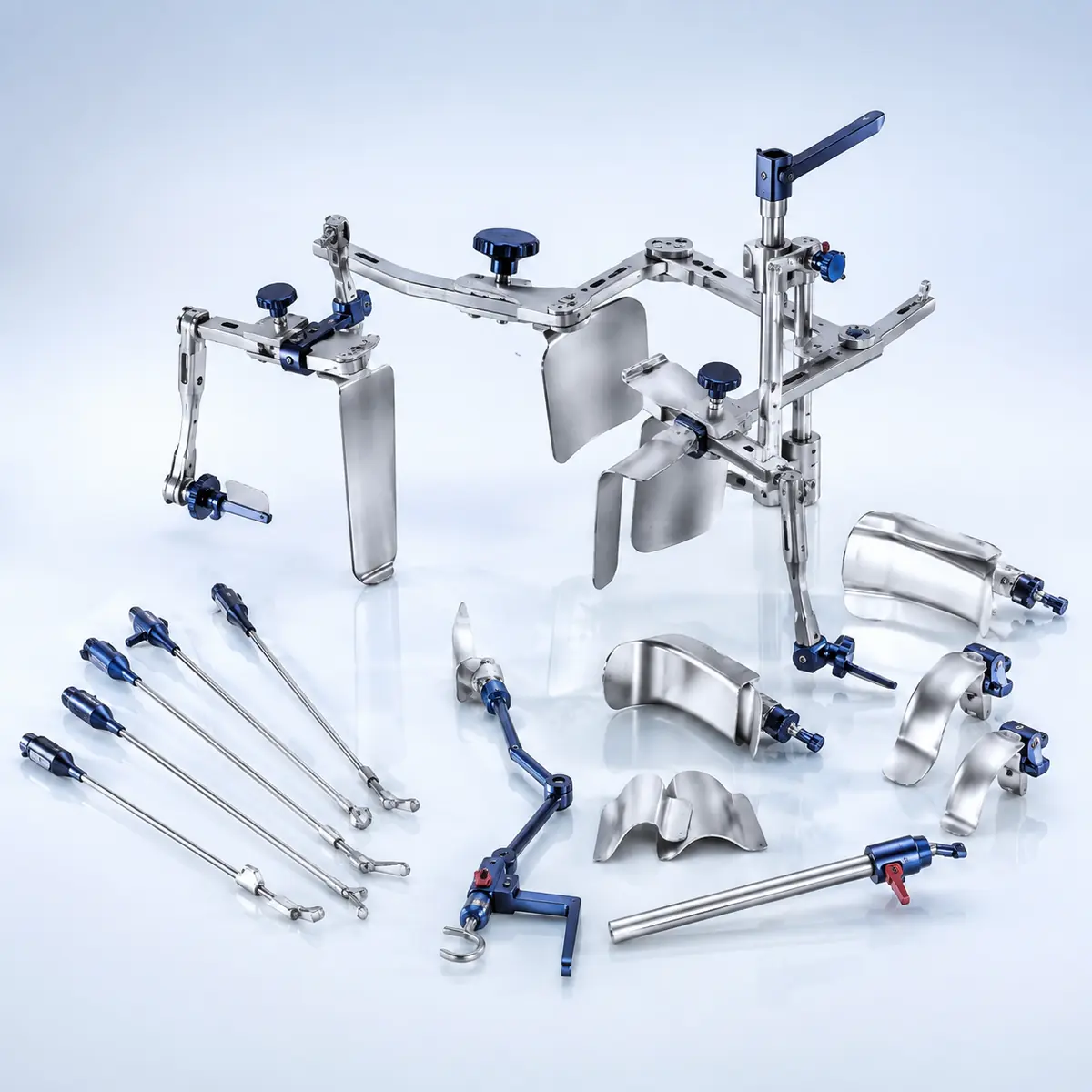
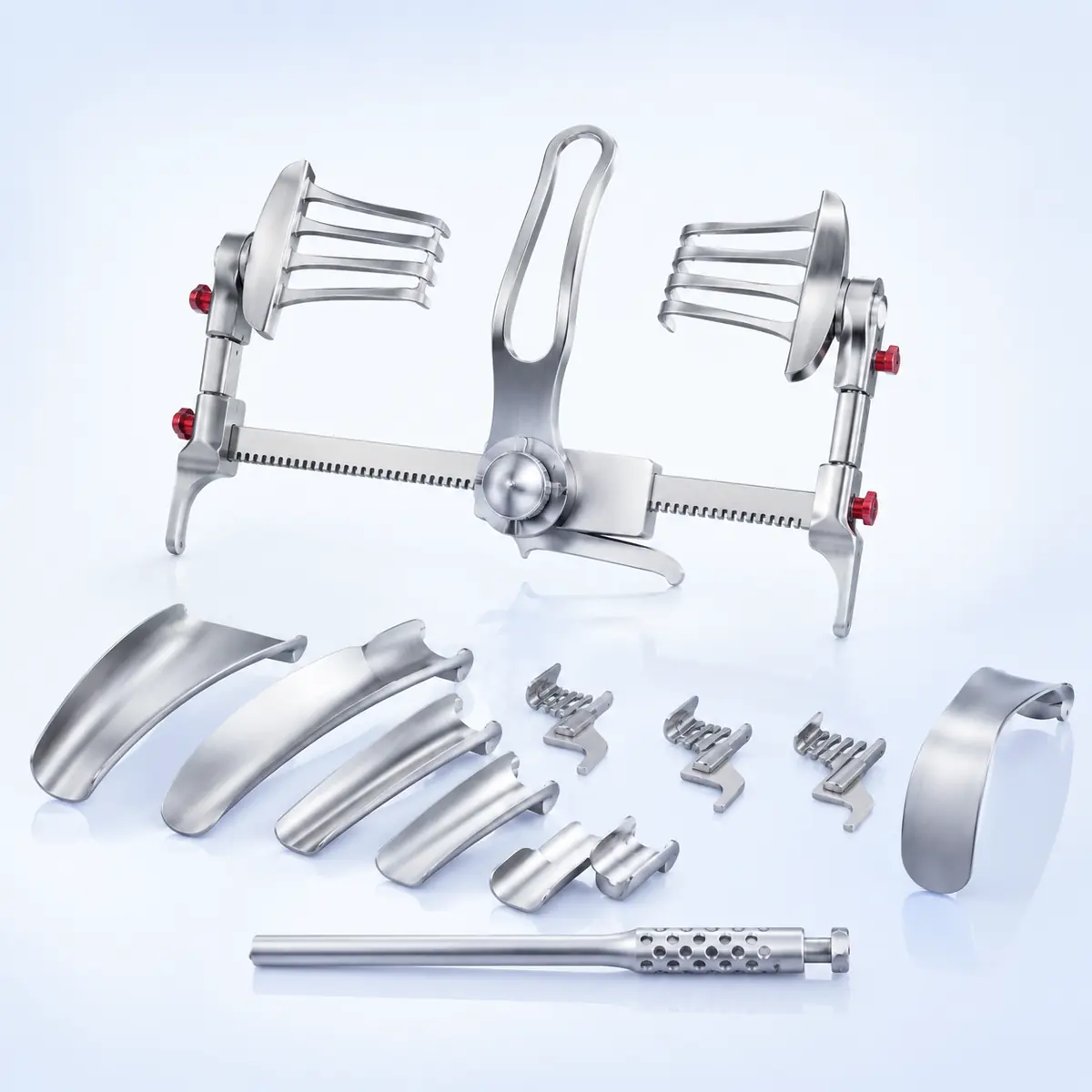
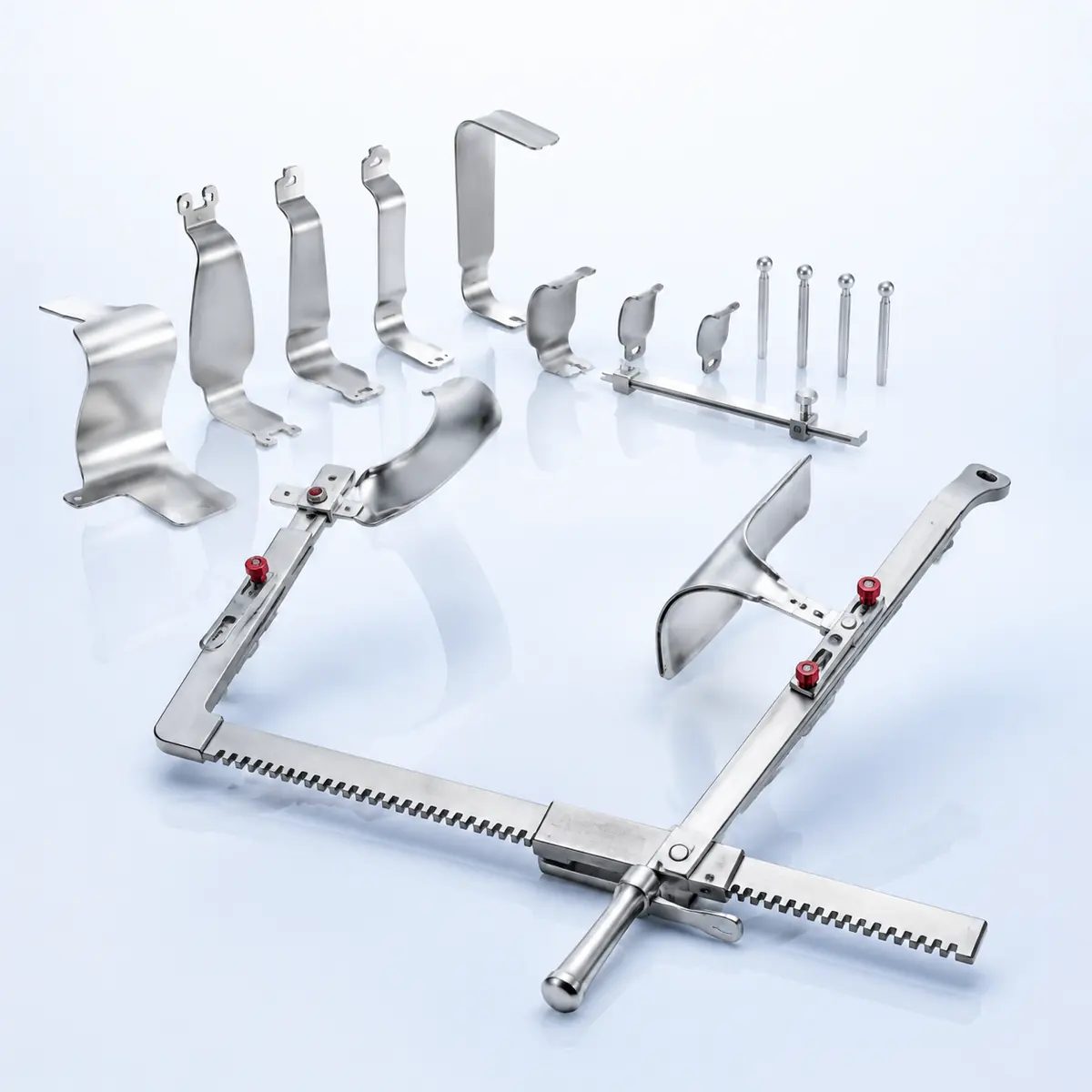
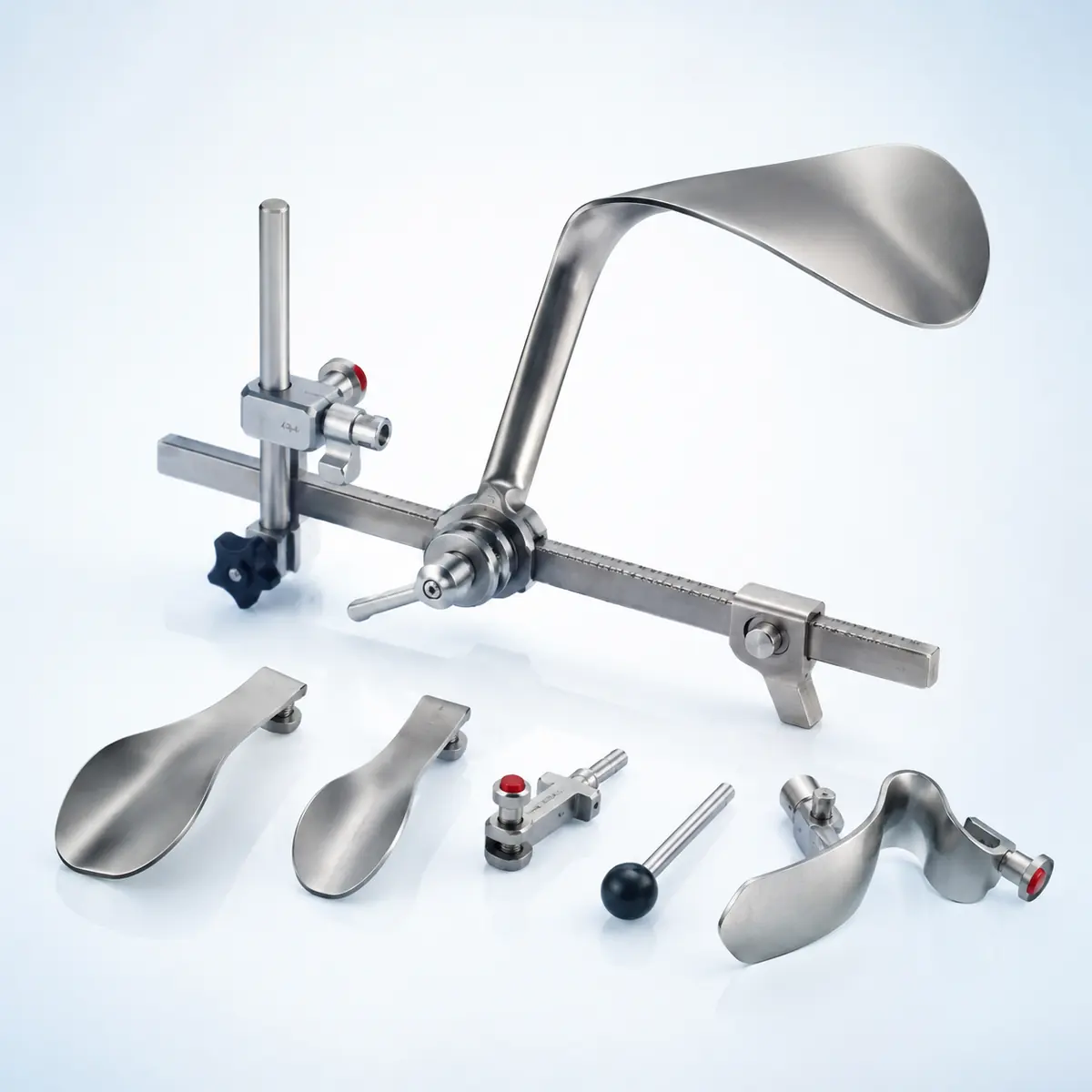
Laparoscopic Retractors surgical instrument on a clean clinical blue background
Product Overview

What Is a Laparoscopic Retractor?

A laparoscopic retractor is a minimally invasive surgical instrument designed to hold, elevate or move tissue or an organ away from the working area. It is introduced through a compatible laparoscopic access port or positioned using an approved minimally invasive technique.

Unlike a handheld grasper, a retractor may have:

Laparoscopic retractors are intended for use by qualified healthcare professionals. This page provides product-selection and procurement information and does not replace surgical training or the product instructions for use.
Expandable fan blades
A curved liver-supporting blade
A rigid or flexible shaft
An elevation mechanism
A proximal connection for a holding arm
A self-retaining support arrangement
Multiple hooks or supporting components

The required retractor should be selected according to its approved intended use, dimensions and support-system compatibility.

Product Categories

Explore Our Laparoscopic Retractors

Bharat Surgical manufactures and supplies reusable laparoscopic retractors for hospitals, surgical centres, dealers, distributors and medical-equipment buyers.

Fan Retractor

The retractable distal fingers open inside the operative cavity to create a broader supporting surface than a single narrow blade.

Read More

Liver Retractor

Bharat Surgical offers reusable laparoscopic liver retractors for controlled elevation and positioning of the liver during minimally invasive upper-abdominal procedures.

Read More

Nathanson Retractor

Bharat Surgical offers reusable Nathanson liver retractors for controlled liver elevation during laparoscopic, bariatric and selected robotic-assisted upper-abdominal procedures.

Read More
BSC Product Range

Bharat Surgical Laparoscopic Retractor Range

Retractor Published configuration Material
Fan Retractor with Elevation – 3 Blade Three-blade elevated fan design Stainless steel
SS Laparoscopic Fan Retractor – 5 Blade Five-blade fan with elevation Stainless steel
5 mm Five-Blade Elevated Fan Retractor 5 mm shaft; five expandable blades Stainless steel
Fan Retractor – Simple Type Expandable fan pattern without a specified elevation mechanism Confirm with quotation
Nathanson Retractor Curved liver-retractor pattern Stainless steel
Nathanson Liver Retractor – Rigid Curved medium blade; listed for a 5 mm port Stainless steel
Nathanson Flexible Retractor Flexible configuration with three hooks and scoop holder listed Stainless steel
Nathanson Flex-Arm Retractor Adjustable or flexible-arm configuration Stainless steel
Laparoscopic Liver Retractor Liver-retractor configuration Stainless steel
10 mm Liver Retractor 10 mm size; hexagonal connection mentioned Stainless steel
Self-Retaining Retractor Self-retaining configuration listed Stainless steel
Thompson Retractor Table-mounted/open retraction system listed in the category Stainless steel

The range is compiled from Bharat Surgical’s dedicated laparoscopic retractor catalogue and its broader laparoscopic instrument listings. Final dimensions and components should be controlled by the approved quotation and technical drawing.

Retractors Details

Published Technical Information

Parameter Published range or information
Product category Reusable laparoscopic retractors
Common designs Fan, elevated fan, Nathanson and liver retractors
Fan blade options Three-blade and five-blade options
Published shaft sizes 5 mm and 10 mm models mentioned
Blade configurations Expandable fan, curved liver blade and hook/scoop arrangements
Construction Stainless steel on published models
Shaft style Rigid and flexible options
Support style Handheld, self-retaining or holder-supported depending on model
Reusability Reusable models listed
Sterilisation Several models described as autoclavable
Sterile status Varies between listings; confirm per model
Port compatibility 5 mm published for selected models
Working length Not consistently published
Maximum expanded width Not consistently published
Holder or arm May be required; inclusion must be confirmed
Country of origin Made in India on selected listings
Retractors Details

Fan Retractor

A fan retractor has multiple narrow blades that remain together during introduction and spread into a fan-like profile at the working end when operated according to the product instructions.

Published Bharat Surgical options include:

Three-blade fan retractor
Five-blade fan retractor
Elevated fan retractor
Five-blade 5 mm elevated fan retractor
Simple fan-retractor configuration

For each fan retractor, confirm:

Shaft diameter
Working length
Number of blades
Maximum expanded width
Blade thickness
Blade-tip design
Elevation range
Opening and closing mechanism
Rotation
Handle configuration
Compatible trocar
Reprocessing method
Retractors Details

Elevated Fan Retractor

An elevated fan retractor combines expandable blades with a mechanism that changes the angle or elevation of the deployed fan. This can provide a different retraction direction from a simple flat fan design.

The buyer should verify:

Elevation angle
Fan width
Blade count
Locking mechanism
Rotation
Port size
Shaft length
Whether elevation is controlled from the handle
Whether a separate holder is required
Retractors Details

Nathanson Retractor

A Nathanson-pattern retractor normally has a curved distal blade intended to support or elevate the liver. The proximal end may connect to a compatible positioning arm or table-mounted holder.

The range may include:

Standard Nathanson retractor
Rigid Nathanson liver retractor
Flexible Nathanson retractor
Nathanson flex-arm configuration

Multiple blade or hook sizes “Nathanson” describes a recognised retractor pattern, but it does not establish compatibility with every support arm or table-mounted system.

Retractors Details

Laparoscopic Liver Retractor

“Liver retractor” is a broader category that may include:

Nathanson-pattern retractors
Fan retractors
Curved rigid blades
Flexible supporting blades 5 mm or 10 mm shafts
Retractors with hexagonal proximal fittings

The required design should be specified rather than ordering only by the general term “liver retractor.”

Product Comparison

Three-Blade vs Five-Blade Fan Retractor

Point Three-blade fan retractor Five-blade fan retractor
Blade count Three Five
Expanded profile Generally narrower or less segmented Generally broader or more segmented
Access requirement Depends on shaft and folded-blade diameter Depends on shaft and folded-blade diameter
Published option Elevation model listed Elevated and 5 mm models listed
Selection basis Required exposure, access and surgeon preference Required exposure, access and surgeon preference
Information required Expanded width and blade dimensions Expanded width and blade dimensions

A higher blade count should not automatically be described as safer or better. The appropriate pattern depends on the intended application and approved product design.

Product Comparison

Rigid vs Flexible Nathanson Retractor

Feature Rigid Nathanson Flexible Nathanson
Shaft or blade behaviour Maintains a fixed manufactured shape May permit controlled shaping or adjustment
Published Bharat option Rigid curved medium-blade model Flexible model with three hooks and scoop holder listed
Positioning Depends on the holder and proximal connection Depends on shaping limits and holder
Reprocessing Inspect fixed curves and connection Inspect flexible sections for fatigue and deformation
Procurement requirement Specify blade size and support-system fitting Specify adjustment range, components and holder

A flexible retractor should be shaped only within the limits stated in its IFU. Repeated uncontrolled bending may damage the instrument.

Retractors Details

Rigid Nathanson Liver Retractor: Published Configuration

Parameter Published information
Retractor type Listed as snake/Nathanson liver retractor
Blade size Medium
Blade shape Curved
Compatible port 5 mm port listed
Actuation Self-retaining description published
Usage Laparoscopic surgery
Reusability Reusable
Material Stainless steel
Sterile status Sterile listing
Sterilisation Described as autoclavable
Country of origin Made in India

“Self-retaining” should be clarified. Many Nathanson-pattern retractors require a compatible holding or positioning arm to remain fixed. The quotation should state whether the holder, clamp and table connection are included.

Retractors Details

Retractor, Holder and Table-Clamp Compatibility

A complete retraction setup may require:

Operating table rail
Table clamp
Positioning or flex arm
Quick-connect or hex fitting
Laparoscopic retractor

Before ordering, confirm:

Operating-table rail dimensions
Table-clamp type
Positioning-arm model
Arm length and articulation
Locking mechanism
Proximal retractor fitting
Hexagonal or quick-connect dimensions
Maximum permitted load
Sterile and non-sterile components
Whether an isolation drape is required
Which components are included
Reprocessing method for each component
A retractor and holder from different manufacturers should not be combined unless the connection and load compatibility are documented.
Retractors Details

Does the Retractor Include a Holding Arm?

Not necessarily. A listing may refer only to the surgical retractor blade or shaft.

The quotation should separately identify:

Retractor
Positioning arm
Table clamp
Quick-connect adapter
Extension rod
Scoop holder
Hooks
Sterile drape
Carrying or sterilisation tray
Any required tools

This avoids receiving a retractor that cannot be secured with the hospital’s existing system.

Retractors Details

Port and Trocar Compatibility

For port-based retractors, confirm:

Folded or closed instrument diameter
Maximum shaft diameter
Trocar internal working channel
Reducer requirement
Valve and seal compatibility
Blade-opening clearance
Working length
Shaft insulation, if applicable
Rotation clearance
Removal configuration

A nominally 5 mm retractor may not pass through every trocar labelled 5 mm because internal-channel and seal designs differ.

Retractors Details

Blade Size and Expanded Width

Fan retractors should not be selected only by shaft diameter. Buyers also need:

Closed distal profile
Number of blades
Individual blade length
Maximum fan width
Elevation angle
Blade-tip geometry
Maximum permitted load
Minimum access-space requirement

For Nathanson and liver retractors, request:

Blade width
Blade length
Curve radius
Small, medium or large designation
Proximal connection
Overall length
Working length

Manufacturer size names such as “medium” are not standardised across brands.

Product Comparison

Self-Retaining vs Handheld Retraction

Point Self-retaining or holder-supported Handheld
Position maintenance Secured using an approved mechanism Maintained by an operator
Additional equipment May require an arm, clamp or frame Usually no table-mounted system
Procurement Complete system compatibility is important Handle and shaft dimensions are important
Setup Connection and locking must be verified Instrument handling must be evaluated
Inspection Retractor plus holder and locking joints Retractor mechanism and handle

The product’s approved instructions should define whether it can be used with a support arm.

Product Comparison

Laparoscopic vs Open Retractors

The Bharat Surgical category also mentions a Thompson retractor. Thompson-type systems are generally associated with open surgical retraction and should not automatically be presented as laparoscopic instruments.

Laparoscopic retractor Open retractor
Designed for minimally invasive access Used through an open incision
May pass through a trocar Does not normally require a trocar
Long narrow shaft Broader blades and frame components may be used
Fan or curved liver patterns Langenbeck, Deaver, Richardson and frame-mounted patterns
Port diameter is important Blade width, depth and frame compatibility are important

Products should be assigned to the correct category according to their approved intended use.

Retractors Details

Inspection Before Use

Qualified personnel should inspect the retractor and support system according to the product IFU.

Fan retractor

  • Confirm all blades are present
  • Inspect blade alignment
  • Check opening and closing
  • Confirm complete blade closure
  • Test elevation movement
  • Inspect the distal hinge
  • Check rotation
  • Look for bent or separated blades
  • Check for trapped residue

Nathanson or liver retractor

  • Inspect the blade curve
  • Check for cracks, bending or distortion
  • Inspect welds and joints
  • Check the proximal fitting
  • Confirm secure attachment to the holder
  • Examine flexible sections for fatigue
  • Verify that the holder locks correctly

Holding arm and clamp

  • Check all joints
  • Confirm controlled articulation
  • Inspect the locking mechanism
  • Check the table-rail clamp
  • Inspect quick-connect fittings
  • Confirm that components do not slip
  • Verify that no parts are missing
Safety & Maintenance Mandate

Damaged, incomplete or insecure components should be removed from service.

Cleaning & Care

Cleaning, Sterilisation and Reprocessing

Reprocessing Care Guidelines

Reusable retractors must be reprocessed according to their model-specific validated instructions.

The process may include:

Positioning arms, table clamps and retractors may have different reprocessing requirements. Do not immerse or sterilise a component unless its instructions permit it.

Reprocessing Checklist
Point-of-use removal of gross contamination
Transport in a protected container
Disassembly only where approved
Opening fan blades as instructed for cleaning
Cleaning blade hinges, joints and elevation mechanisms
Brushing accessible surfaces
Flushing only approved channels
Thorough rinsing
Complete drying
Magnified visual inspection
Functional inspection
Packaging in an approved tray
Validated steam sterilisation
Protected storage
Retractors Details

Maintenance and Repair

Potential maintenance requirements include:

Fan-blade alignment
Elevation-mechanism repair
Shaft straightening, where approved
Rotation-mechanism service
Hinge repair
Proximal-fitting replacement
Holder-joint maintenance
Locking-system adjustment
Table-clamp service
Surface refinishing
Functional inspection

Repairs should restore the original mechanical dimensions and connection security without weakening the blades or support system.

B2B Supply Channels

Information for Hospitals and Procurement Teams

A technically complete enquiry should include:

Retractor type
Intended organ or tissue
Fan or curved-blade requirement
Number of fan blades
Shaft diameter
Compatible port
Working length
Maximum expanded width
Elevation requirement
Rigid or flexible construction
Blade size
Rotation requirement
Proximal connection
Existing holder brand and model
Table-rail dimensions
Required arm and clamp
Sterile or non-sterile supply
Quantity
Sample requirement
Reprocessing documentation
Delivery destination
B2B Supply Channels

Information for Dealers and Distributors

Dealer and distributor enquiries may request:

Complete model list
Product codes
Blade and connection photographs
Standard dimensions
Price list
Minimum order quantity
Private-labelling availability
Packaging
Export documentation
Spare components
Repair support
Sample policy
Production and dispatch schedule

Registration and labelling requirements must be agreed for the destination market.

Retractors Details

Suggested BOQ Description

Suggested Tender/BOQ Text Template Copy for procurement document

"Reusable Laparoscopic Retractor, [three-blade/five-blade fan/Nathanson/liver] pattern, stainless-steel construction, [5 mm/10 mm] shaft, approximately [working length], with [simple/elevated/rigid/flexible] working end and [specified maximum expanded width or blade size]. To include [positioning arm, table clamp, quick-connect adapter and sterilisation tray, if required]. Supplier to confirm trocar compatibility, component list, sterile-supply status and validated reprocessing instructions."

Separate BOQ lines should be used for the retractor, support arm, table clamp and accessories when they are not supplied as one complete system.

Selection Guide

Why Choose Bharat Surgical?

Multiple laparoscopic retractor configurations
Three-blade and five-blade fan options
Elevated fan-retractor models
Rigid and flexible Nathanson options
Published 5 mm and 10 mm configurations
Stainless-steel reusable instruments
Liver-retractor and holding-system discussions
Hospital and dealer enquiries accepted
Bulk-order and export support
Product samples subject to commercial terms
Custom dimensions subject to feasibility
Repair support for reusable instruments subject to evaluation

Final specifications, component lists, certifications and regulatory status should be confirmed for the exact quoted model.

BSC Product Range

Related Products

Immediate Answers

Frequently Asked Questions

Find technical, reprocessing, ordering, and size compatibility answers for the Bharat Surgical Retractors range.

It is an instrument designed to hold or elevate tissue or an organ during minimally invasive surgery.

The published range includes fan retractors, elevated fan retractors, Nathanson retractors and laparoscopic liver retractors.

It is a retractor with multiple distal blades that expand into a fan-shaped working profile according to the product’s operating mechanism.

Yes. A fan retractor with three blades and an elevation configuration is listed.

Yes. Stainless-steel five-blade and 5 mm elevated five-blade options are listed.

Not automatically. Selection depends on the required expanded profile, access, working space and surgeon preference.

It combines an expandable fan with a mechanism that changes the elevation or angle of the deployed blades.

It is a fan-pattern retractor without a separately identified elevation mechanism. Exact construction should be confirmed.

It is a curved retractor pattern commonly selected for liver support or elevation and may connect to a positioning arm.

Yes. A reusable rigid model with a curved, medium-sized blade is listed.

Yes. A flexible configuration with three hooks and a scoop holder is listed, subject to final component confirmation.

It is a retractor configuration involving an adjustable or flexible positioning arrangement. The exact arm and accessory package must be confirmed.

Selected models are listed for a 5 mm port, while a 10 mm liver-retractor option is also available. Verify each model individually.

No. Trocar channel, valve, seal and instrument-profile dimensions must be checked.

Working lengths are not consistently published. State the required length in the enquiry.

The available listings do not consistently provide this value. Request it for the exact three- or five-blade model.

Not necessarily. The quotation should state whether the arm, table clamp and adapter are included.

It uses a table-rail clamp and positioning arm to hold the retractor in a selected position.

No. Hexagonal fittings, quick-connect adapters, arm dimensions and load limits differ.

It means the retractor can maintain its position through an approved retaining mechanism. Some models still require a separate positioning arm.

Reusable stainless-steel options are listed. Follow the validated inspection and reprocessing instructions.

Several models are described as autoclavable. Use only the validated cycle for the exact product.

Sterile-status information varies. Confirm whether each model is supplied sterile or non-sterile.

Check blade count, alignment, opening, closing, elevation, hinges, rotation and complete blade closure.

Check the curve, blade surface, shaft, joints, proximal connection and secure fit with the holder.

Look for fatigue, kinks, cracks, distortion and loss of controlled positioning. Follow its IFU.

No. It should only be adjusted within the limits stated by the manufacturer.

Follow the product-specific IFU, ensuring that blades, hinges and hidden joint surfaces are accessible during cleaning.

Only if the holding arm’s instructions approve the same process. Different system components may require different treatment.

A standard Thompson-type retractor is generally an open-surgery, table-mounted system. It should be classified separately unless specific laparoscopic components are documented.

Custom dimensions may be discussed subject to technical feasibility, quantity, validation and regulatory requirements.

Sample evaluation may be discussed subject to availability and commercial terms.

Yes, subject to product configuration, quantity, packaging and destination-market documentation.

Provide the retractor pattern, port size, working length, blade size or fan width, holder requirement, quantity and delivery location.

Purchase them together when compatibility with an existing support system cannot be documented.

Request Laparoscopic Retractor Price

Price depends on: For an accurate quotation, specify whether the requirement is for the retractor alone or a complete retractor, arm and table-clamp system.
Factors Affecting Price: Retractor pattern, Shaft diameter, Working length, Number of fan blades, Maximum expanded width, Elevation mechanism, Rigid or flexible construction, Blade size, Support arm, Table clamp, Quick-connect components, Sterile-supply status, Packaging, Quantity, Export documentation, Delivery destination