ISO 13485:2016 Certified
40+ Years of Excellence
600+ Products
Download Catalog
MANUFACTURER & SUPPLIER | B2B LAPAROSCOPIC INSTRUMENTS

Laparoscopic Liver Retractor
Manufacturer and Supplier in India

Bharat Surgical offers reusable laparoscopic liver retractors for controlled elevation and positioning of the liver during minimally invasive upper-abdominal procedures. The range can include Nathanson-style, fan, articulating, finger-style and other liver-retraction configurations.

Hospitals, bariatric surgery centres, surgeons, medical colleges, surgical instrument dealers and distributors can contact Bharat Surgical for retractor-size selection, compatible holding systems and bulk-order quotations.

ISO 13485:2016 Certified
40+ Years Experience
Mumbai Warehousing
Laparoscopic Liver Retractor
Manufacturer and Supplier in India
Overview

Reusable Liver Retractors for Laparoscopic Surgery

A laparoscopic liver retractor is used to elevate or displace part of the liver to improve access and visibility during upper-abdominal surgery. The instrument is positioned against an appropriate liver surface and maintained manually or through a compatible holding arm.

A liver-retraction system may include:

Liver retractor blade or hook
Proximal shaft
Holder connection
Flexible or rigid positioning arm
Operating-table rail clamp
Quick-release mechanism
Multiple blade sizes
Sterilisation tray

The correct retractor should provide the required surgical exposure while avoiding unnecessary concentrated or prolonged pressure.

Why Liver Retraction Is Required

The left lobe of the liver can obstruct access to structures in the upper abdomen. Controlled retraction may improve exposure of the:

Gastro-oesophageal junction
Stomach
Diaphragmatic hiatus
Upper abdominal operative field
Gallbladder region
Pancreatic or hepatobiliary field
Other structures covered by the liver

The retractor type, contact surface, lifting direction and duration should be selected for the individual procedure and patient anatomy.

Retractor Types

Types of Laparoscopic Liver Retractors

Types of Laparoscopic Liver Retractors

Nathanson Liver Retractor: A curved hook-style instrument designed to support and elevate the liver. It is commonly available in multiple sizes and is frequently connected to a table-mounted holding arm. A separate Level 4 page should cover its sizes, fitting and selection in detail.

Fan Liver Retractor: A long-shaft retractor with distal fingers that open into a fan after introduction. It creates an adjustable support surface and must be fully closed before withdrawal.

Articulating Liver Retractor: The distal section changes shape or angle after insertion. Articulating models may include right-angle, triangular, angled-triangular or finger-style configurations.

Finger-Style Retractor: A shaped or articulating distal section supports the liver over a defined contact area. Finger-style designs differ from expandable multi-finger fan retractors.

Cuschieri-Style Liver Retractor: A laparoscopic liver retractor with an adjustable distal end that forms or expands inside the operative cavity. Exact construction and operating method vary by model.

Paddle or Blade Liver Retractor: Uses a broad distal blade or paddle to elevate the liver. The blade width, curvature and access requirement should be confirmed.

Port-Free Internal Liver Retractor: An internal suspension device can support the liver without leaving a rigid retractor shaft through a dedicated port. Such devices are typically system-specific and may be single-use.

Liver Retractor Sizes

Liver retractors are available in multiple sizes because one hook or blade does not suit every patient and procedure. Selection may depend on liver size, patient anatomy, abdominal-wall thickness, required elevation, operative approach, access-point position, distal blade length, retractor curvature, contact surface, holding-arm location, and robotic-arm clearance.

Size categoryGeneral selection consideration
Extra-smallSmaller anatomy or limited operative space
SmallFocused contact surface and compact access
MediumGeneral upper-abdominal retraction requirements
LargeBroader liver support where anatomy and access permit
Extended-tip modelThicker abdominal wall or increased reach requirement

The surgeon should select the size according to anatomy and the required contact area. “Large” from one manufacturer may not match “large” from another.

Specifications

Product Features and Technical Specifications

Product Features

Depending on the model, features may include:

Reusable surgical construction
Broad liver-contact surface
Multiple blade or hook sizes
Straight, curved or articulating configuration
Fixed or adjustable distal shape
Standard or extended reach
Compatible holder connection
Hexagonal or other anti-rotation fitting
Quick-connect attachment
Table-mounted positioning
Manual or hands-free retraction
Matte or low-reflection finish on designated models
Dismantling construction
Individual or set supply

Only verified features should be published for Bharat Surgical’s exact product.

Technical Specification Options

SpecificationAvailable selection
ProductLaparoscopic liver retractor
Retractor designNathanson, fan, articulating, finger, paddle or specified pattern
SizeExtra-small, small, medium, large or dimension-specific
Contact surfaceAccording to selected blade or hook
Shaft diameterModel-specific
Distal-tip lengthAccording to retractor size
Working lengthStandard, extended or procedure-specific
ArticulationFixed or adjustable
Holder connectionHexagonal, round, quick-connect or specified fitting
UseManual or holder-mounted
ConstructionReusable or single-use, according to model
DisassemblyOne-piece, detachable or modular
Holding armIncluded or supplied separately
Rail clampIncluded or supplied separately
SterilisationAccording to supplied instructions
PackingIndividual, set or institutional packing

Exact dimensions, material, load limitations and reprocessing instructions must come from Bharat Surgical’s approved technical specification.

Systems & Comparisons

Retraction Systems, Fixation & Design Comparisons

Manual vs Hands-Free Liver Retraction

Manual Retraction: An assistant holds and adjusts the liver retractor. Considerations: immediate repositioning, continuous operator control, requires an assistant, position can vary with hand movement, and sustained holding may cause fatigue.

Holder-Mounted Retraction: The retractor is fixed to an approved table-mounted or flexible holding arm. Considerations: maintains the selected position, can free an assistant’s hand, requires secure rail and arm installation, needs a compatible proximal fitting, must allow rapid release or adjustment, and position/tissue pressure must still be monitored (hands-free does not mean pressure-free or unattended).

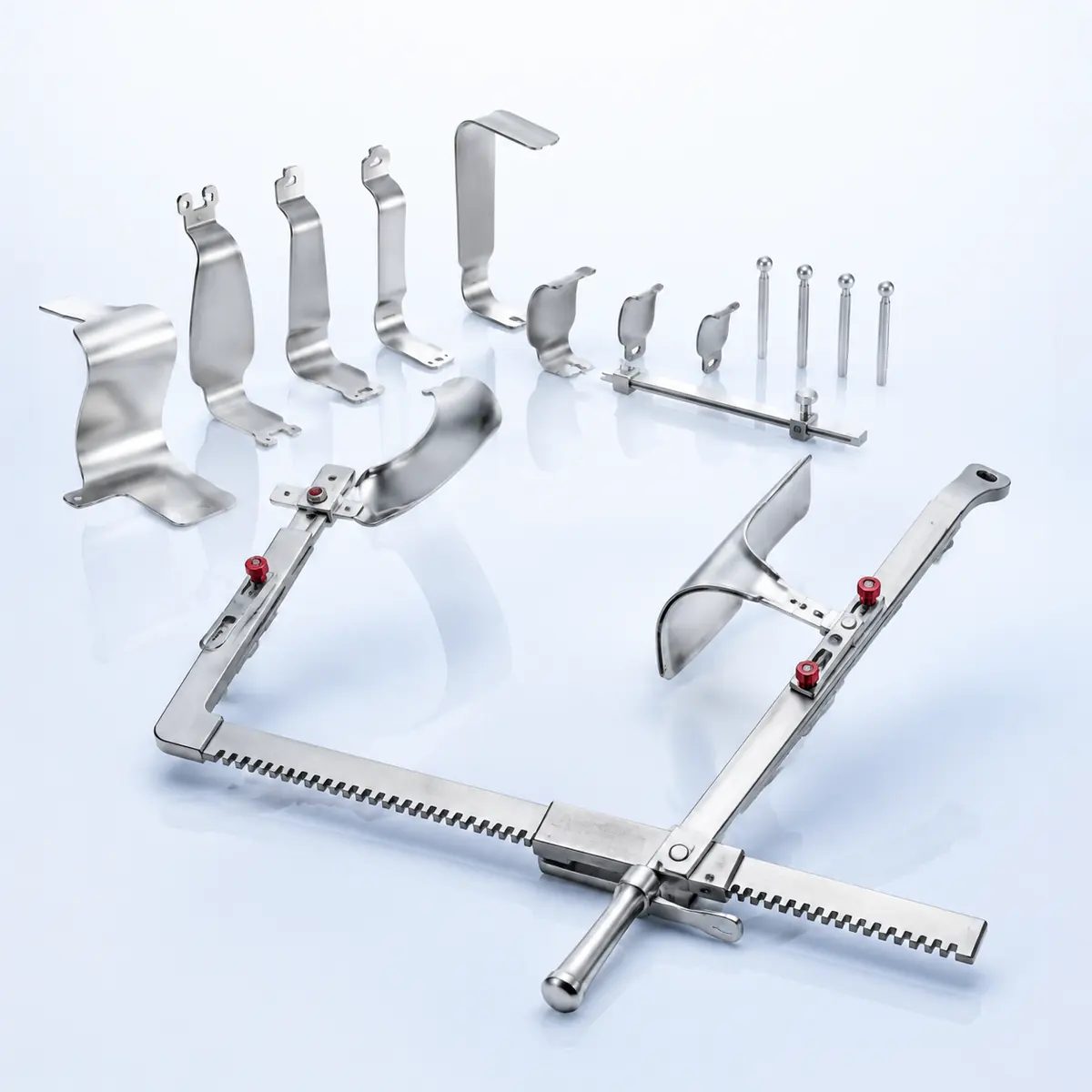
Components of a Complete Liver Retractor System

A complete system may contain:

Liver retractor in one or more sizes
Flexible or rigid holding arm
Table-rail clamp
Quick-connect fitting
Anti-rotation connector
Vertical or horizontal support post
Sterilisation or storage tray
Cleaning instructions and spare parts

The quotation should list every included component. Do not assume that a product labelled “liver retractor” includes the holding arm and rail clamp.

Fixed vs Articulating Liver Retractors

Fixed retractorArticulating retractor
Distal shape is predeterminedDistal shape forms or changes after insertion
Simpler constructionMore complex internal mechanism
Multiple sizes may be neededOne design may offer positional adjustment
Generally easier to inspectRequires inspection of flexible links or joints
Common in Nathanson-style systemsCommon in self-forming or triangular systems
Positioned as a complete shaped instrumentIntroduced compactly and articulated internally

Liver Retractor vs Fan Retractor

Liver retractorFan retractor
Category designed or selected for liver elevationExpandable multi-finger retractor
May use a fixed hook or broad bladeOpens into a fan inside the cavity
Commonly connected to a holderMay be handheld or holder-mounted
Available in multiple hook sizesAvailable in different finger counts and widths
Contact shape is often predeterminedContact width can be adjusted
May support a broader portion of liverMay provide more localised support
Applications & Selection

Specialty Applications and Selection Guidelines

Laparoscopic Liver Retractor Applications

Depending on the exact product and intended use, liver retractors may be used during selected:

Bariatric surgery
Sleeve gastrectomy
Gastric bypass procedures
Anti-reflux and GERD procedures
Fundoplication
Hiatal hernia procedures
Upper gastrointestinal surgery
Oesophageal procedures
Laparoscopic cholecystectomy
Hepatobiliary and pancreatic procedures
Robotic upper-abdominal surgery

Not every retractor is appropriate for every listed application.

Liver Retractor vs Nathanson Retractor

A liver retractor is the overall product category. A Nathanson retractor is one specific curved design within that category.

Generic liver retractorNathanson retractor
Includes several blade and articulating designsUses a curved hook-style form
May be fixed, fan or self-formingGenerally fixed in shape
Holder connection variesCommonly supplied with a defined proximal fitting
Application depends on designPrimarily used for liver elevation
May require a trocarPositioning approach depends on model and technique

Bariatric & Robotic Requirements

Bariatric Surgery: May require wider liver support, extended working length, increased distance from table rail to operative site, a stable holding arm, a retractor suitable for thicker abdominal walls, positioning that does not interfere with other instruments, and different hook/blade sizes for varying liver anatomy.

Robotic Surgery: Requirements include clearance between the retractor and robotic arms, proximal shaft length, holder position, angle of elevation, prevention of external collision, stable anti-rotation connection, port placement, and rapid retractor adjustment. A standard model should not be marketed as robotic-compatible without verification.

How to Select the Correct Liver Retractor

Identify the Procedure: Specify bariatric, upper-GI, hepatobiliary, robotic or another application.

Select Retractor Pattern & Size: Choose Nathanson, fan, articulating, or paddle and provide actual blade/hook dimensions rather than only S/M/L.

Check Wall Thickness & Holding Method: Confirm if extended reach is needed and state manual vs holder-mounted preference.

Match Holder Fitting & Rail Clamp: Verify hexagonal, round, or quick-connect fittings and table-rail dimensions.

Robotic Clearance & Reprocessing: Check arm clearance and ensure hospital reprocessing compatibility.

Reprocessing & Safety

Reprocessing, Pre-Use Inspection and Safety Controls

Cleaning and Sterilisation

Reusable liver retractors and holding systems must be reprocessed according to their individual instructions. General precautions include:

Prevent blood and tissue residue from drying
Separate removable components as instructed
Clean the entire blade or hook surface
Brush joints, fittings and locking features
Flush channels in articulating models
Clean holder connectors separately
Use compatible detergents, rinse thoroughly and dry all components
Inspect for retained soil and check blade, shaft and connection
Test holding arm and quick release before reassembly
Sterilise using validated cycle (do not sterilise non-permitted holders/clamps)

Common Ordering Mistakes

Ordering only by the term “liver retractor”
Not specifying Nathanson, fan or articulating design
Selecting only by small, medium or large without dimensions
Not confirming whether the holder is included
Ordering a retractor without matching its proximal fitting
Ignoring operating-table rail compatibility
Not specifying bariatric or robotic use
Assuming every model fits through a trocar
Buying only one size for all patient anatomies

Inspection Before Use

Inspect the retractor for:

Correct size and pattern
Smooth contact surface without sharp edges
No bending, deformation, corrosion or cracks
Secure proximal fitting and anti-rotation engagement
Proper articulation, where applicable
Secure holder locking and reliable quick release
Correct rail-clamp attachment and complete assembly

Safe Retraction Considerations & Risk Controls

Select correct size; position retractor under direct visualisation.
Avoid narrow edges against liver; apply only required force for exposure.
Monitor liver throughout; avoid excessive or prolonged focal pressure.
Reassess position after table movement; ensure holding arm remains locked.
Avoid external collisions with robotic arms; maintain rapid release method.
Release pressure before major repositioning; do not exceed holder load limits.
B2B Supply

Supply Channels and Details Required for Quotation

Supply for Hospitals, Dealers and Distributors

Bharat Surgical supports enquiries from:

Multispeciality hospitals
Laparoscopy centres
Bariatric surgery centres
Upper-GI surgery departments
Robotic surgery centres
Medical colleges
Government procurement departments
Surgical instrument dealers
Medical equipment distributors
Bulk institutional buyers
Export buyers

Product availability, documentation, holder configuration, packing and delivery time depend on the selected system.

Why Buy Liver Retractors from Bharat Surgical?

Multiple laparoscopic retractor designs
Standard and procedure-specific size options
Retractor-only and complete-system quotations
Compatible holder and rail-clamp support
Bariatric and robotic configuration assistance
Hospital and institutional supply
Dealer and distributor support
Bulk-order quotations
Repair support where technically feasible
Documentation according to the supplied model

All specifications and compatibility claims must correspond to the exact system supplied.

Information Required for a Quotation

Please provide:

Intended surgical application (standard, bariatric or robotic)
Retractor design (Nathanson, fan, articulating, etc.)
Required size and distal-tip/blade dimensions
Shaft diameter and working length
Fixed or articulating design
Manual or holder-mounted use
Required holder fitting and existing holder photographs
Table-rail dimensions
Complete system or retractor only
Required quantity and delivery destination
Hospital, dealer, distributor or export enquiry
Documentation and branding/packing requirements
Immediate Answers

Frequently Asked Questions

Technical, sizing, system-mounting and reprocessing answers for the Bharat Surgical Laparoscopic Liver Retractor range.

It is an instrument used to elevate or position the liver to improve visibility and access during minimally invasive upper-abdominal surgery.

Common categories include Nathanson, fan, articulating, finger-style, paddle and port-free internal retractors.

The Nathanson design is widely used, but the correct retractor depends on the procedure, patient anatomy and holding system.

No. Nathanson is one particular type within the wider liver-retractor category.

Selected fan retractors may be used for liver elevation, but suitability depends on the required contact surface and procedure.

Yes. Size options may include extra-small, small, medium, large and extended-tip configurations.

Consider liver size, abdominal-wall thickness, contact area, access point and required elevation.

Only when the quotation specifies a complete system. Retractors, holders and rail clamps may be supplied separately.

It is a proximal connection designed to engage a matching holder while resisting unwanted rotation.

No. Retractor fitting, load rating, locking mechanism and rail connection must be compatible.

A compatible holder-mounted system can maintain retraction, but the tissue and system still require monitoring.

Yes. Bariatric configurations may require a larger contact surface, extended reach or long-reach holding arm.

Robotic-compatible configurations may be needed to reduce interference with robotic arms and provide appropriate clearance.

Many reusable models are designed for steam sterilisation, but the exact validated cycle must be confirmed from the supplied instructions.

No. Access requirements differ. Some retractors use a trocar or small dedicated access point, while internal suspension systems may be port-free.

Check the blade or hook, shaft, fitting, holder, rail clamp, articulation and quick-release mechanism.

Excessive or prolonged concentrated pressure can potentially injure tissue. Position and pressure should be monitored.

Complete systems may include multiple retractors, a holding arm, rail clamp, connection fitting and tray, depending on the quotation.

Yes, subject to confirming its size and compatibility with the existing holder.

Hospitals, dealers, distributors, medical colleges and export buyers can request bulk quotations.

Medical and Procurement Disclaimer: Established systems confirm that laparoscopic liver retractors include multiple Nathanson sizes, holder-mounted configurations, articulating designs and port-free internal suspension options. Exact Bharat Surgical specifications must be verified separately (Mediflex Nathanson systems, Mediflex articulating retractors, KARL STORZ Nathanson liver retractor). Next Level 4 page: Nathanson Retractor.

Request a Liver Retractor Quotation

Looking for a laparoscopic liver retractor manufacturer or supplier in India? Share the required design, size, distal-tip dimensions, holding-arm connection, surgical application and quantity with Bharat Surgical. Our team can assist with individual retractors, multiple-size sets and complete holder systems.