ISO 13485:2016 Certified
40+ Years of Excellence
600+ Products
Download Catalog
MANUFACTURER & SUPPLIER | B2B LAPAROSCOPIC INSTRUMENTS

Laparoscopic Satinsky Clamp and Endo Knife
Manufacturer in India

Bharat Surgical manufactures and supplies reusable laparoscopic instruments for hospitals, surgical centres, dealers and distributors. This page covers two different instruments: the laparoscopic Satinsky vascular clamp and the laparoscopic Endo Knife. A Satinsky clamp is designed for vascular clamping, while an Endo Knife is a cutting or dissection instrument. Buyers must specify which instrument is required and confirm its jaw or blade design, shaft diameter, working length, handle, locking mechanism and electrosurgical classification.

ISO 13485:2016 Certified
40+ Years Experience
Mumbai Warehousing
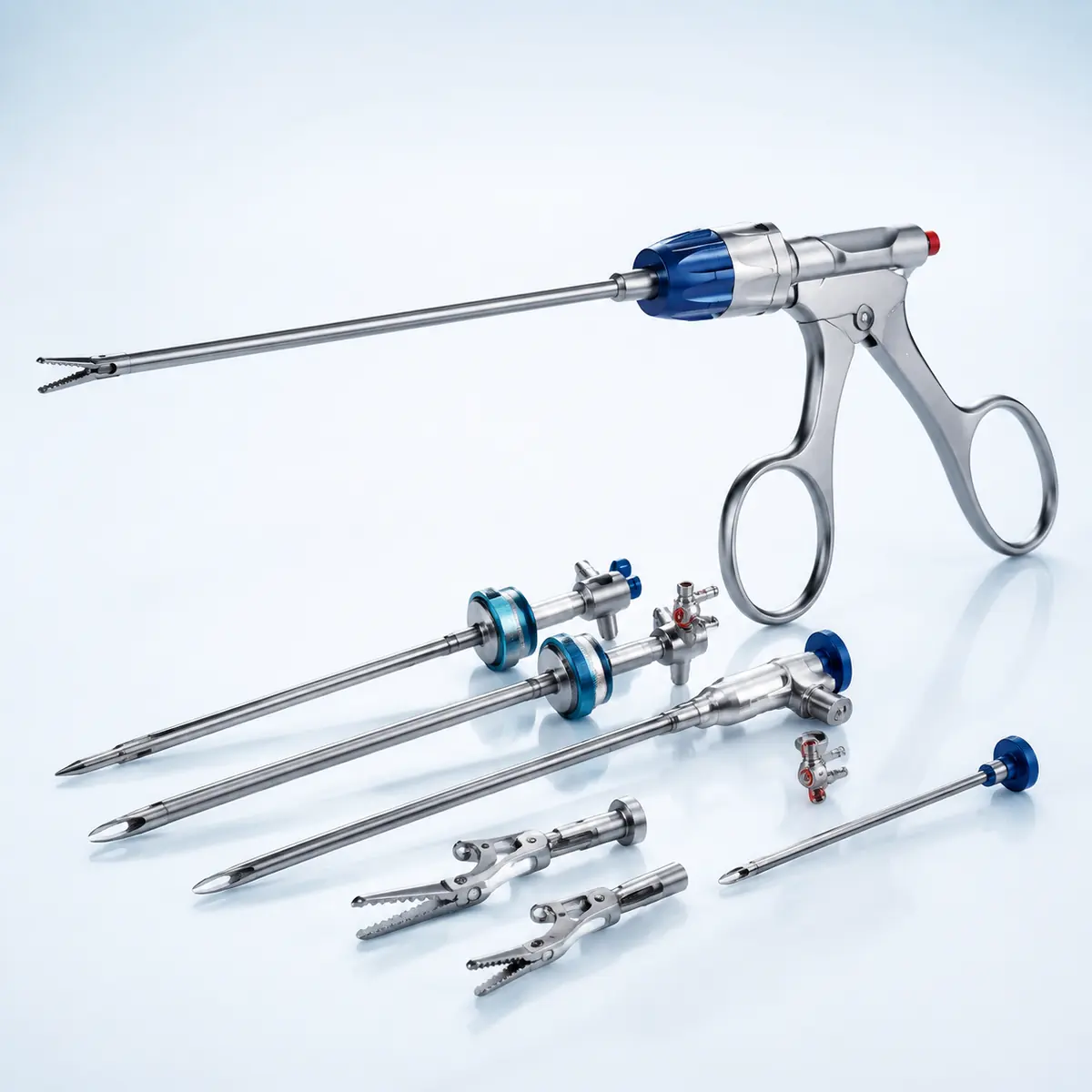
Satinsky Clamp / Endo Knife surgical instrument on a clean clinical blue background
Satinsky Clamp / Endo Knife Details

Important Sitemap and Product Clarification

These instruments are intended for use by qualified healthcare professionals. This page provides procurement information and does not replace surgical training or the product instructions for use.

The Satinsky clamp and Endo Knife are mechanically and functionally different instruments. They should remain clearly separated within this page.

Bharat Surgical’s published catalogue verifies a Laparoscopic Endo Knife, but a dedicated Bharat Surgical laparoscopic Satinsky clamp specification could not be located in the available online listings.

Before publication, Bharat Surgical should confirm:

Whether a laparoscopic Satinsky clamp is manufactured
Whether “Satinsky” was confused with the published “Stasanky Needle Holder”
Available Satinsky jaw patterns and sizes
Whether the Satinsky model is mechanical or monopolar-compatible
Whether Satinsky and Endo Knife are sold as separate products
Whether these products should eventually have separate URLs

The published Stasanky Needle Holder is a needle-holding instrument and should not be presented as a Satinsky vascular clamp.

Product Overview

What Is a Laparoscopic Satinsky Clamp?

A laparoscopic Satinsky clamp is a long-shaft vascular clamping instrument with angled jaws designed to provide controlled partial or complete occlusion when used for its approved vascular application.

Common design characteristics may include:

Angled or Double-Angled Jaws

Designed to fit vascular anatomy and allow partial occlusion.

DeBakey-Pattern Serrations

Fine atraumatic vascular teeth to avoid damage to vessels.

Long Laparoscopic Shaft

Typically 330 mm working length for abdominal access.

Ratcheted Handle

Allows the surgeon to apply locked, precise clamping force.

Single-Action Jaw

One jaw pivots while the other remains fixed for control.

Fixed or Detachable Construction

Modular or single-assembly options for surgical care.

Insulated Shaft Options

Ensures safety when vascular clamps are used near active energy.

Short- and Long-Jaw Options

Varying jaw lengths to match targeted vascular structures.

Clinical Notice & Safety Guidance

These are general market characteristics. Bharat Surgical’s exact Satinsky configuration requires verification.

Product Overview

What Is a Laparoscopic Endo Knife?

A laparoscopic Endo Knife is a long-shaft cutting instrument with a sharpened distal working end for an approved minimally invasive cutting or dissection application.

The Bharat Surgical listing describes its Endo Knife as:

Laparoscopic Cutting Instrument

Designed specifically for precise abdominal tissue cuts.

Stainless-Steel Construction

Durable surgical metal construction for cutting edge retention.

Black-Coloured Component

Identifies model markings and structural parts.

Size Field of 5-10 mm

Compatible with standard 5 mm and 10 mm trocar cannulas.

Reusable / Non-Disposable

Designed to be fully reprocessed for multiple surgical uses.

Autoclavable Design

Withstands standard steam sterilization parameters.

Available as New Instrument

Supplied directly in fresh, factory-new condition.

Clinical Notice & Safety Guidance

The listing does not establish the exact shaft diameter, working length, blade pattern or electrosurgical capability.

Specifications

Published Bharat Surgical Endo Knife Specifications

Parameter Published specification
Product Laparoscopic Endo Knife
Category Cutting instrument
Material Stainless steel
Colour Black
Published size field 5–10 mm
Disposability Non-disposable
Condition New
Usage Hospital and clinical use
Reusability Reusable description
Sterilisation Described as autoclavable
Minimum order quantity Two pieces listed
Shaft diameter Requires confirmation
Working length Not published
Blade shape Not published
Blade length Not published
Handle type Not published
Rotation Not published
Electrosurgical function Not established
Sterile supply Confirm with quotation

These details are taken from Bharat Surgical’s published Laparoscopic Endo Knife listing.

Specifications

Satinsky Clamp Specifications Required

Parameter Required confirmation
Exact product name Laparoscopic Satinsky Clamp
Catalogue number To be confirmed
Shaft diameter To be confirmed
Working length To be confirmed
Jaw length To be confirmed
Jaw geometry Angled or double angled
Jaw profile DeBakey, cross-serrated or other
Short- or long-jaw option To be confirmed
Jaw action Single or double action
Ratchet To be confirmed
Handle Ring, axial or other
Construction Fixed or detachable
Shaft insulation To be confirmed
Electrosurgical classification Mechanical, monopolar or other
Maximum rated voltage Required if electrosurgical
Compatible cable Required if electrosurgical
Compatible trocar To be confirmed
Reusability To be confirmed
Sterile supply To be confirmed
Reprocessing Model-specific IFU required
Satinsky Clamp / Endo Knife Details

General Reference for Laparoscopic Satinsky Designs

Aesculap publishes laparoscopic Satinsky-pattern clamps with 5 mm shafts, approximately 310 mm working lengths, short and long angled jaws, DeBakey toothing, single-action mechanisms and detachable construction. These specifications apply only to the cited Aesculap models and must not be copied as Bharat Surgical specifications.

The reference demonstrates which dimensions hospitals commonly need when comparing a laparoscopic Satinsky clamp. See the official Aesculap laparoscopic vascular clamp range.

Product Comparison

Satinsky Clamp vs Stasanky Needle Holder

Point Satinsky clamp Stasanky needle holder
Instrument type Vascular clamp Needle holder
Working end Angled vascular jaws Curved needle-holding jaws
Primary mechanical function Vascular clamping Holding and guiding a suturing needle
Published Bharat data Dedicated model not verified 5 mm × 330 mm model published
Jaw insert Vascular serration must be confirmed Tungsten-carbide insert listed
Page classification Vascular or laparoscopic clamp Laparoscopic needle holder

The names are similar but the instruments are not interchangeable.

Product Comparison

Satinsky Clamp vs Endo Knife

Feature Satinsky clamp Endo Knife
Primary function Clamping Cutting or dissection
Working end Opposing angled jaws Sharp blade
Handle control Opens, closes and may lock the jaws Controls or positions the blade
Ratchet Common on many clamp designs Not normally required unless model-specific
Blade No cutting blade on standard clamp Distal cutting edge
Electrosurgical capability Model-dependent Model-dependent
Main selection criteria Jaw length, serration, angle and closing mechanism Blade shape, sharpness, shaft and handle

These products require separate specifications and should never share one generic product image.

Product Comparison

Satinsky Clamp vs Standard Laparoscopic Grasper

Satinsky clamp Laparoscopic grasper
Specialised angled vascular-jaw pattern Multiple general grasping-jaw patterns
May be designed for partial occlusion Designed for tissue grasping or manipulation
Jaw pressure and vascular serration are critical Serration and fenestration depend on the grasper
Ratchet commonly specified Locking depends on model
Requires dedicated vascular-clamp validation Should not be substituted for a vascular clamp
Product Comparison

Endo Knife vs Laparoscopic Scissors

Endo Knife Laparoscopic scissors
Uses a single distal blade or knife edge Uses two opposing cutting blades
Cutting depends on blade movement and instrument design Cutting occurs through scissor action
Blade pattern must be specified Blade curvature and action must be specified
May have a fixed cutting edge May be single- or double-action
Requires inspection of the exposed blade Requires inspection of blade alignment and pivot
Product Comparison

Endo Knife vs Monopolar Hook or Spatula

Point Mechanical Endo Knife Monopolar hook or spatula
Cutting principle Sharp mechanical edge Electrosurgical energy
Generator Not required for a purely mechanical model Required
Cable Not required for a purely mechanical model Compatible monopolar cable required
Patient-return pathway Not applicable to mechanical cutting Normally required for conventional monopolar use
Main inspection Blade integrity and sharpness Electrode and insulation integrity

The Bharat Surgical Endo Knife listing does not establish electrosurgical capability. It should be treated as mechanical unless product-specific documentation states otherwise.

Selection Guide

Endo Knife Blade Options to Confirm

The technical datasheet should identify whether the available blade is:

Also request:

Straight
Curved
Hooked
Spear-point
Lancet-shaped
Blunt-tipped
Retractable
Fixed
Replaceable
Integrated into a detachable insert
Blade length
Blade width
Cutting-edge orientation
Single- or double-edged design
Protective mechanism
Maximum exposed blade length
Satinsky Clamp / Endo Knife Details

Interpreting the 5–10 mm Endo Knife Size Field

The published size field states 5–10 mm, but it is unclear whether this refers to:

Available shaft diameters
Compatible trocar sizes
Product family range
Blade dimensions
Catalogue classification

Do not publish both 5 mm and 10 mm as confirmed shaft sizes until Bharat Surgical supplies model-wise data.

Satinsky Clamp / Endo Knife Details

Shaft Diameter and Trocar Compatibility

For either instrument, confirm:

Nominal shaft diameter
Maximum diameter at joints
Closed-jaw or protected-blade profile
Trocar internal working channel
Valve and seal compatibility
Required reducer
Working length
Jaw-opening or blade-clearance requirement
Rotation clearance
Removal configuration

Nominal diameter does not guarantee compatibility with every trocar carrying the same size label.

Working Length

The datasheet should distinguish:

Overall instrument length
Working shaft length
Jaw or blade length
Handle length
Effective reach

Approximately 310–330 mm is common in many standard laparoscopic instruments, but no working length should be assigned to the Bharat Endo Knife or Satinsky clamp until verified.

Satinsky Clamp / Endo Knife Details

Satinsky Jaw Options

Common RFQ options may include:

Short angled jaw
Long angled jaw
Double-angled jaw
DeBakey-pattern serration
Fine cross-serration
Small, medium or large pattern
Single-action jaw
Detachable insert

Availability must be confirmed by Bharat Surgical.

Product Comparison

Fixed vs Detachable Construction

Fixed instrument Detachable instrument
Handle, shaft and working end remain assembled Handle, outer sheath and insert can separate
Fewer assembly steps Components can be individually inspected
Complete instrument repaired as one unit Individual compatible parts may be replaced
Cleaning access depends on design Approved disassembly can improve access
One model code may define the instrument Multiple component codes are required

Components from different manufacturers must not be mixed without documented compatibility.

Product Comparison

Mechanical vs Electrosurgical Classification

Both the Satinsky clamp and Endo Knife require a clear classification.

If mechanical

Confirm:

No energy connection
No cable
No generator requirement
Non-insulated or mechanically insulated handle
Mechanical intended use
If monopolar-compatible

Confirm:

Maximum rated voltage
Approved generator modes
Cable and connector
Patient-return-electrode requirement
Shaft insulation
Handle insulation
Product-specific warnings
Approved activation method

A black handle or insulated-looking shaft does not prove electrosurgical compatibility.

Pre-Use Inspection: Satinsky Clamp
Jaws
Confirm correct jaw pattern
Check jaw alignment
Inspect vascular serrations
Look for bending or deformation
Confirm full opening and closing
Inspect jaw tips
Check hinge movement
Confirm no corrosion or residue
Satinsky Clamp / Endo Knife Details

Ratchet and handle

Check ratchet engagement
Confirm controlled release
Inspect ring handles
Check for cracks or looseness
Confirm jaw movement corresponds with handle movement
Shaft and insulation
Check shaft straightness
Inspect connections
Inspect insulation where fitted
Confirm secure assembly
Check rotation where provided
Pre-Use Inspection: Endo Knife
Blade
Inspect cutting edge
Check for bending or chipping
Confirm correct blade orientation
Inspect the tip
Check the blade-to-shaft connection
Verify the protective or retracting mechanism, where provided
Confirm there is no corrosion or residue
Shaft and handle
Check shaft straightness
Inspect rotation
Confirm handle movement
Check detachable connections
Inspect insulation if the model is electrosurgical
Confirm correct assembly

A damaged, loose or blunt blade should be removed from service.

Cleaning & Care

Cleaning, Sterilisation and Reprocessing

Reprocessing Care Guidelines

Reusable clamps and knives must be reprocessed according to their separate product-specific instructions.

The process may include:

Sharp Endo Knife components require an approved handling and protective method during cleaning and packaging.

Reprocessing Checklist
Point-of-use removal of gross contamination
Protected transport
Approved disassembly
Cleaning jaws, blade, hinges and ratchets
Cleaning detachable shafts and inserts
Flushing only approved channels
Thorough rinsing
Complete drying
Magnified inspection
Functional testing
Insulation testing where applicable
Approved packaging
Validated sterilisation
Protected storage
Maintenance and Repair
Satinsky clamp
Jaw alignment
Serration condition
Hinge adjustment
Ratchet repair
Shaft straightness
Rotation repair
Insulation evaluation
Endo Knife
Blade assessment
Blade replacement, if permitted
Shaft repair
Retraction-mechanism repair
Handle repair
Insert or sheath replacement
Insulation evaluation
Repair should restore the original working-end geometry and mechanical function.
Information for Hospitals and Procurement Teams
Satinsky clamp enquiry
Short- or long-jaw model
Jaw length
Jaw angle
Serration pattern
Shaft diameter
Working length
Single- or double-action
Ratchet requirement
Fixed or detachable design
Mechanical or electrosurgical
Trocar size
Quantity
Endo Knife enquiry
Blade pattern
Blade length and width
Shaft diameter
Working length
Fixed or retractable blade
Fixed or detachable construction
Mechanical or electrosurgical
Handle type
Rotation
Trocar size
Quantity
Selection Guide

Why Choose Bharat Surgical?

Published reusable Laparoscopic Endo Knife
Stainless-steel laparoscopic instrument manufacturing
Fixed and detachable instrument capability across the range
Multiple laparoscopic handle options
Hospital and institutional enquiries
Dealer and distributor support
Bulk and export-order support
Samples subject to commercial terms
Custom configurations subject to feasibility
Repair evaluation for reusable instruments

A Bharat Surgical Satinsky-clamp model should be added to this section only after its specifications are approved.

BSC Product Range

Related Products

Immediate Answers

Frequently Asked Questions

Find technical, reprocessing, ordering, and size compatibility answers for the Bharat Surgical Satinsky Clamp / Endo Knife range.

No. A Satinsky is a vascular clamp, while an Endo Knife is a cutting instrument.

They appear together in the approved sitemap. Their content and enquiry forms should remain clearly separated.

A dedicated Bharat Surgical Satinsky model could not be verified in the available online catalogue.

Yes. A reusable stainless-steel Laparoscopic Endo Knife is listed.

No. A Satinsky is a vascular clamp; the published Stasanky instrument is a needle holder.

It is a long-shaft clamp with angled vascular jaws designed for an approved partial or complete vascular-clamping application.

It is a long-shaft minimally invasive instrument with a sharp distal blade for an approved cutting or dissection application.

Common patterns include short and long angled jaws with fine or DeBakey-style serration. Bharat Surgical availability must be confirmed.

Straight, curved, hook and spear-point patterns may be requested, but the Bharat range must be confirmed.

The listing contains a 5–10 mm size field but does not clearly identify model-wise shaft diameters.

Bharat Surgical’s working length is not published. State the required length in the enquiry.

It is not stated in the published listing and must be confirmed.

Ratcheted construction is common, but the Bharat model requires verification.

A standard Endo Knife normally does not need a vascular-clamp ratchet. Handle design should be confirmed.

Many laparoscopic Satinsky designs use single-action jaws, but Bharat Surgical’s model must be confirmed.

Yes. The published Bharat model is described as reusable and non-disposable.

It is described as autoclavable. Use only the product-specific validated cycle.

Sterile-supply status is not clearly published. Confirm it in the quotation.

The proposed page is for a reusable model, but Bharat Surgical must confirm the exact product.

It may be mechanical or monopolar-compatible depending on design. The exact Bharat classification is not verified.

The published listing does not establish electrosurgical capability. Treat it as mechanical unless the datasheet states otherwise.

Only if the exact model is designed, insulated and validated for electrosurgical use.

No. Shaft, joints, closed working end, trocar channel, valve and seal must be compatible.

No. A Satinsky clamp has specialised angled vascular jaws and should not be replaced by a general grasper.

No. An Endo Knife uses a knife edge, while scissors use two opposing blades.

No. A mechanical Endo Knife cuts using a sharp edge; a monopolar hook uses electrosurgical energy.

Check alignment, serrations, angle, tips, opening, closing, hinge and ratchet.

Check the edge, tip, blade alignment, blade-to-shaft connection and any protective or retracting mechanism.

It should be evaluated through an approved repair process. Uncontrolled sharpening may alter blade geometry.

Follow separate model-specific IFUs, paying attention to jaws, blades, hinges, ratchets and detachable connections.

No compatibility should be assumed. Handle, sheath and insert must form an approved system.

Custom configurations may be discussed subject to technical feasibility, quantity, validation and regulatory requirements.

Sample evaluation may be discussed after the exact configuration is confirmed.

Yes, subject to approved product configuration, quantity, packaging and documentation.

Provide the instrument name, jaw or blade pattern, diameter, length, handle, quantity and delivery destination.

Yes, separate pages would provide clearer buyer intent and SEO targeting if both products are confirmed as active Bharat Surgical products.

Request Satinsky Clamp and Endo Knife Price

Price depends on: Request separate quotations for the Satinsky clamp and Endo Knife.
Factors Affecting Price: Required instrument, Jaw or blade pattern, Shaft diameter, Working length, Jaw or blade dimensions, Ratchet mechanism, Rotation, Fixed or detachable construction, Mechanical or electrosurgical classification, Cable inclusion, Sterile-supply status, Quantity, Packaging, Export documentation, Delivery destination