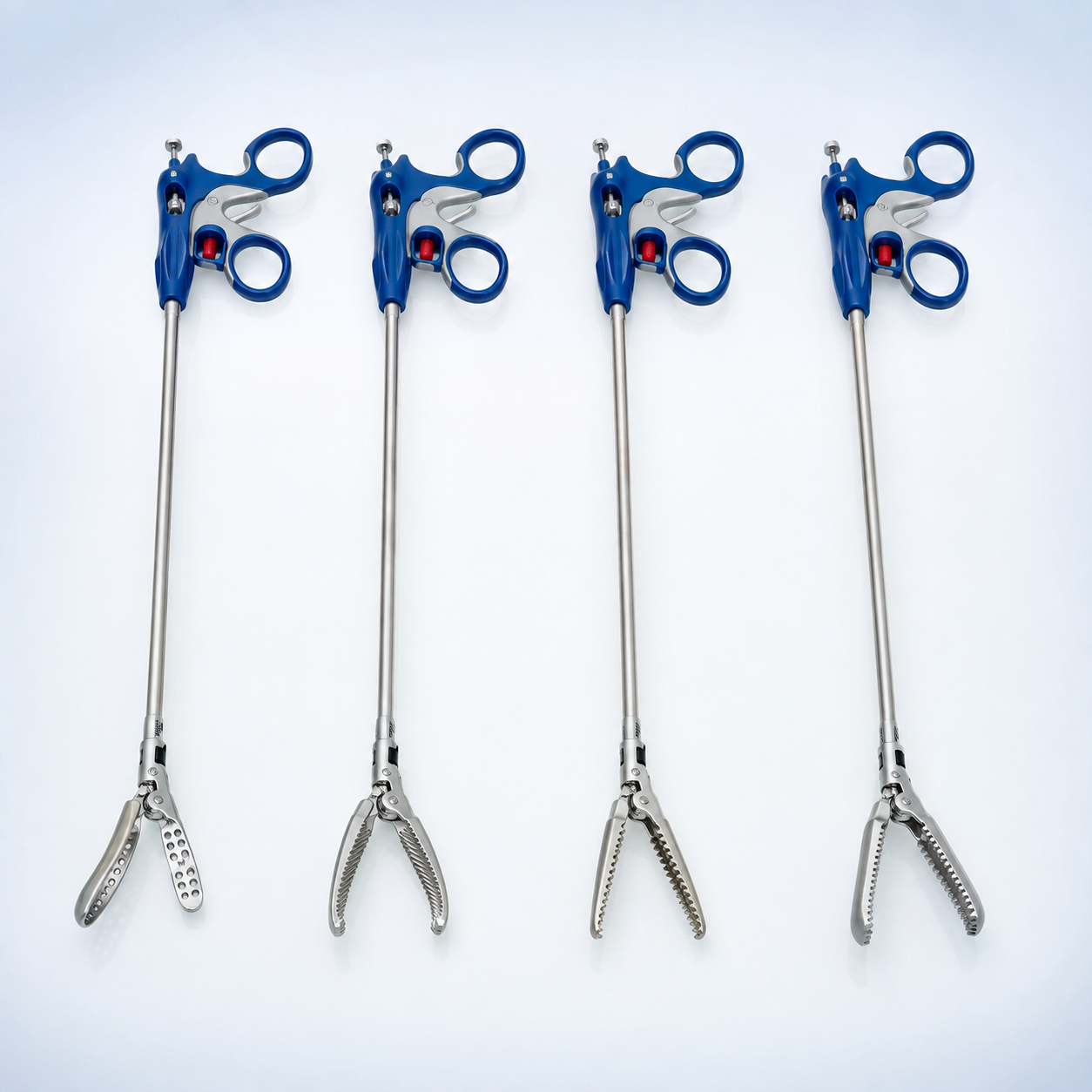
Laparoscopic graspers are long-shaft instruments used to hold, retract, manipulate or present tissue during minimally invasive surgery. Common types include atraumatic fenestrated, bowel, Babcock, Johan, Maryland, dolphin-nose, toothed and claw graspers.
The right grasper must be selected according to the tissue, required holding force, procedure, jaw pattern, shaft diameter, working length, handle, rotation and energy compatibility. A grasper's commercial name alone is not enough for safe selection.
General descriptions only. Actual indications, jaw profiles and energy capabilities depend on the individual product.
| Grasper Type | Jaw Characteristics | Typical Use |
|---|---|---|
| Atraumatic fenestrated grasper | Broad, open or fenestrated jaws with a less aggressive gripping surface | Holding and retracting delicate tissue |
| Bowel grasper | Broad, atraumatic jaw intended to spread pressure | Manipulating bowel and other delicate structures |
| Babcock grasper | Rounded, fenestrated jaws | Holding tubular or delicate structures |
| Johan grasper | Fenestrated, atraumatic-style jaw | General tissue holding and retraction |
| Maryland grasper / dissector | Fine, curved and tapered jaw | Fine dissection and controlled tissue manipulation |
| Dolphin-nose grasper | Rounded or tapered nose profile | General grasping, dissection and tissue presentation |
| Alligator grasper | Elongated serrated jaws | Holding tissue requiring a firmer grip |
| Toothed grasper | One or more teeth at the distal jaw | Firm engagement of suitable tissue |
| Rat-tooth grasper | Pronounced interlocking tooth pattern | Strong, localized tissue grip |
| Claw grasper | Multiple prongs or claw-like tip | Retrieval or firm holding of suitable material |
| Biopsy grasper | Cup-shaped cutting or grasping jaws | Obtaining tissue samples when indicated |
| Monopolar grasper | Insulated instrument with monopolar connection | Grasping with monopolar coagulation or cutting capability |
| Bipolar grasper | Conductive jaw system connected to compatible bipolar equipment | Grasping with bipolar coagulation capability |
One of the first buying decisions is whether the instrument needs a broad, less aggressive hold or a concentrated, firm grip.
Atraumatic graspers are designed to distribute pressure over a broader contact area and reduce concentrated tissue engagement compared with toothed or claw-type designs. They may be considered for manipulating:
“Atraumatic” does not mean that tissue injury is impossible. Excessive force, prolonged clamping, inappropriate jaw selection or repeated manipulation can still damage tissue.
Traumatic graspers use teeth, sharper serrations or claw-like features to produce a firmer localized hold. They may be considered for:
They should not be selected for delicate tissue unless their use is specifically appropriate for the procedure.
Confirm the exact product specification and instructions for use before ordering any instrument.
A fenestrated grasper contains openings in its jaws. Its broader profile can distribute force across a larger area than a narrow or sharply toothed jaw.
Typical Uses
Confirm Before Buying
Fenestrated does not automatically mean atraumatic. Check the actual edge profile, teeth and intended use.
A bowel grasper generally has long, broad jaws intended to hold or manipulate delicate bowel tissue while distributing pressure.
Typical Uses
Evaluate
A bowel grasper should not be assumed safe for unrestricted clamping. Apply only the force and duration appropriate for the tissue.
A laparoscopic Babcock grasper typically has rounded, fenestrated jaws intended to surround or hold tissue over a relatively broad area.
May Be Considered For
Confirm
Do not treat every rounded fenestrated jaw as an identical Babcock design.
The Johan grasper is commonly offered with a fenestrated, atraumatic-style jaw for general tissue holding and retraction.
Typical Uses
Check
“Johan” may describe different jaw patterns across suppliers. Request a technical drawing or sample before bulk ordering.
A Maryland-pattern instrument generally has fine, curved and tapered jaws. Frequently described as a dissector; some suppliers also classify it as a grasping and dissecting forceps.
Typical Uses
Confirm
Fine Maryland jaws are not a substitute for broad atraumatic bowel graspers. The narrower contact area can create a more concentrated grip.
A dolphin-nose grasper normally has a rounded or tapered distal profile designed for general tissue handling and dissection.
Typical Uses
Verify
The term “dolphin nose” is not always standardized between suppliers. Product-code confirmation is important.
An alligator-style grasper generally has elongated jaws with serrations designed to provide firmer engagement than a broad atraumatic jaw.
Typical Uses
Check
Should not automatically be used on delicate bowel or vascular structures.
A toothed grasper has one or more teeth designed to engage tissue more positively. Common configurations: 1×2 teeth, 2×3 teeth, rat-tooth pattern, fine or heavy toothed jaws.
Typical Uses
Confirm
Teeth must meet correctly when the jaw closes. Bent or misaligned teeth can affect performance and may damage tissue.
A rat-tooth grasper uses a prominent tooth or interlocking tooth arrangement to provide a concentrated hold.
Typical Uses
Evaluate
This is generally not an atraumatic design.
A claw grasper has multiple prongs or a claw-like jaw that closes around the intended object or tissue.
Typical Uses
Confirm
Claw graspers should not be confused with atraumatic tissue-holding forceps.
A biopsy grasper generally has cup-shaped jaws intended to obtain a tissue sample.
Typical Uses
Confirm
A biopsy forceps should be used only for its documented purpose and by appropriately qualified clinicians.
Some insulated grasping or dissecting forceps include a monopolar connection, combining grasping with electrosurgical capability.
Typical Functions
Confirm
Do not connect a mechanical-only grasper to electrosurgical equipment without proper documentation.
A bipolar grasper uses two conductive poles within the jaw system and must be connected to compatible bipolar electrosurgical equipment.
Typical Functions
Confirm
Not every bipolar grasper is a vessel sealer. Confirm the exact intended use and supported generator.
Neither jaw-action design is universally superior. Access space, tissue, visibility and surgeon preference should guide selection.
Common Shaft Diameters:
Approx 3 mm / 3.5 mm (mini-laparoscopy) • 5 mm (conventional) • 10 mm • Procedure-specific sizes. Confirm against trocar internal diameter, cannula seal, reducer requirements and maximum closed-jaw profile.
Common Working Lengths:
30 cm • 33 cm • 36 cm • 43 cm • 45 cm or extended. Depends on port placement, anatomy, patient build, specialty and bariatric access requirement.
Handle Types:
For delicate tissue, the lock must not encourage excessive or prolonged compression. Test with expected gloves, hand position and procedure duration.
Reusable graspers may contain hinges, internal rods, narrow channels, rotating mechanisms, jaw joints and closely fitted surfaces where debris can collect. Follow the product-specific process for:
For monopolar or bipolar instruments, visual inspection alone may not be sufficient. Follow the manufacturer’s prescribed electrical and insulation-testing process.
Check a reusable laparoscopic grasper for:
Remove any questionable instrument from use and send it for authorized assessment.
A general laparoscopic instrument set may include:
Medical college training set may contain:
Training instruments should be inspected regularly because repeated drops, excessive force and incorrect assembly can damage jaws, shafts and ratchets.
Bharat Surgical supplies reusable laparoscopic grasping and dissecting instruments for hospitals, clinics, surgeons, medical colleges, dealers and distributors.
Available configurations may include: Atraumatic graspers, Fenestrated graspers, Bowel graspers, Babcock graspers, Johan graspers, Maryland graspers and dissectors, Dolphin-nose, Toothed, Claw, Monopolar and Bipolar instruments.
ISO 13485:2016 Certified Quality Management System
ISO Registration Number: RQMD91/11579 (Expiry: 11 Sept 2027)
CE Certificate No. 9277
Scope: Manufacture of laparoscopy, urology, ophthalmic, gynecology, neuro, ENT, orthopaedic and general surgery instruments. (Expiry: 15 April 2028)
GSTIN: 27ADFPA5321C1ZA (Maharashtra)
CE applicability and supporting documents must be confirmed for the specific grasper model being quoted.
Include the following in your enquiry:
* Send a photograph of the current instrument and its product markings if specifications are unknown.
Quick answers to the most common questions about laparoscopic grasper selection and procurement.
It is used to grasp, hold, retract, manipulate or present tissue during minimally invasive surgery. Its exact use depends on the jaw design and product instructions.
Common types include atraumatic fenestrated, bowel, Babcock, Johan, Maryland, dolphin-nose, alligator, toothed, rat-tooth, claw and bipolar graspers.
It is a grasper designed to distribute pressure and provide less aggressive tissue engagement than a toothed or claw-type instrument. It can still cause injury if used incorrectly.
A traumatic grasper uses teeth, strong serrations or claw-like features to provide a firmer, more localized grip on suitable tissue or material.
A broad, atraumatic bowel grasper is commonly considered for bowel manipulation. The exact jaw design and intended use must be verified before selection.
It is commonly used to hold tubular or delicate structures with a broad, fenestrated jaw. Applications depend on the product and procedure.
A Johan grasper is generally a fenestrated, atraumatic-style instrument used for tissue holding and retraction. Jaw designs may vary by manufacturer.
It can be described as a Maryland grasper, dissector or grasping-and-dissecting forceps. It normally has fine curved jaws suited to controlled manipulation and dissection.
It means the jaw contains one or more openings. Fenestration may support broader tissue engagement, but it does not automatically make the instrument atraumatic.
A single-action instrument moves one jaw, while a double-action instrument moves both jaws. Suitability depends on access, tissue and surgeon preference.
A ratchet can maintain jaw closure without constant hand pressure. Non-ratcheted handles may provide more direct control and quicker release.
Choose the diameter according to the intended trocar and procedure. Approximately 5 mm is commonly available, while smaller or larger instruments may suit specific requirements.
The length depends on port placement, anatomy and procedure. Standard models may be around 30–36 cm, while longer instruments may be used for selected deep-access or bariatric procedures.
No. Only use monopolar or bipolar energy when the exact instrument is designed for it and connected to compatible equipment according to its instructions.
No. Some bipolar instruments provide coagulation without having an approved vessel-sealing function. Confirm the exact intended use and supported generator.
Not automatically. Follow the current reprocessing instructions for each exact product, including cleaning, disassembly and permitted sterilization parameters.
Inspect cleanliness, jaw alignment, serrations, teeth, movement, ratchet, rotation, shaft, insulation, connectors and assembly according to the product instructions and hospital policy.
Not necessarily. The rotating mechanism adds surfaces that may require additional cleaning steps. Follow the specific instructions for use for each model.
Bharat Surgical supplies reusable laparoscopic grasping and dissecting instruments. Exact jaw patterns, sizes, configurations and availability should be confirmed during enquiry.
Provide the grasper type, jaw pattern, tissue or procedure, diameter, working length, handle, ratchet, rotation, energy requirement, reusable or disposable preference, quantity and delivery location.
Send Bharat Surgical the required jaw type, diameter, length, handle, energy configuration, quantity and delivery details.