ISO 13485:2016 Certified
40+ Years of Excellence
600+ Products
Download Catalog
BUYER GUIDE | SUTURING INSTRUMENT SELECTION

How to Choose a Laparoscopic Needle Holder

Choose a laparoscopic needle holder by matching its jaw design, needle compatibility, shaft diameter, working length, handle style, locking mechanism and reprocessing requirements to the intended surgical procedure.

There is no single needle holder suitable for every surgeon or operation. A model that provides good control during laparoscopic gynecology may not be the preferred design for general surgery, intracorporeal suturing, deep pelvic work or bariatric procedures. The best laparoscopic needle holder is not simply the most expensive model. It is the instrument that securely holds the required needle, supports controlled needle positioning, fits the access port, feels comfortable in the surgeon’s hand and can be correctly cleaned, inspected and sterilized.
ISO 13485:2016 Certified
CE Certified Quality
Jaw & Ergonomic Selection Checklist
How to Choose a Laparoscopic Needle Holder
Pre-Enquiry Check

Quick Needle Holder Selection Checklist

Final selection should be made by the surgeon or qualified clinical team using the exact product specifications and instructions for use.

1. Surgical & Suture Parameters

Surgical specialty • Intended procedure • Expected suture • Needle size and curvature • Suture type

2. Jaw & Interface Specifications

Straight, curved or angled jaw • Left/Right-curved or neutral orientation • Jaw surface and insert material (e.g. Tungsten Carbide)

3. Dimension & Interface Mechanics

3 mm, 5 mm or custom shaft diameter • Working length • Axial, pistol-grip, ring-style handle • Ratcheted/toggle or non-locking

4. Construction & Reprocessing

Dismantling or non-dismantling design • Flushing cleaning port connection • Reusable or single-use requirement

Introduction

What Is a Laparoscopic Needle Holder?

A laparoscopic needle holder is a long-shaft surgical instrument designed to grasp, position and drive a suturing needle during minimally invasive surgery.

Unlike an open surgery needle holder, a laparoscopic model must transmit the surgeon’s hand movement through a narrow access port. Its handle, shaft and jaw must therefore work together to provide controlled needle manipulation at the operative site. It is commonly used in intracorporeal suturing, tissue approximation, defect closure, ligature placement, knot tying, and vaginal cuff/myometrial suturing.

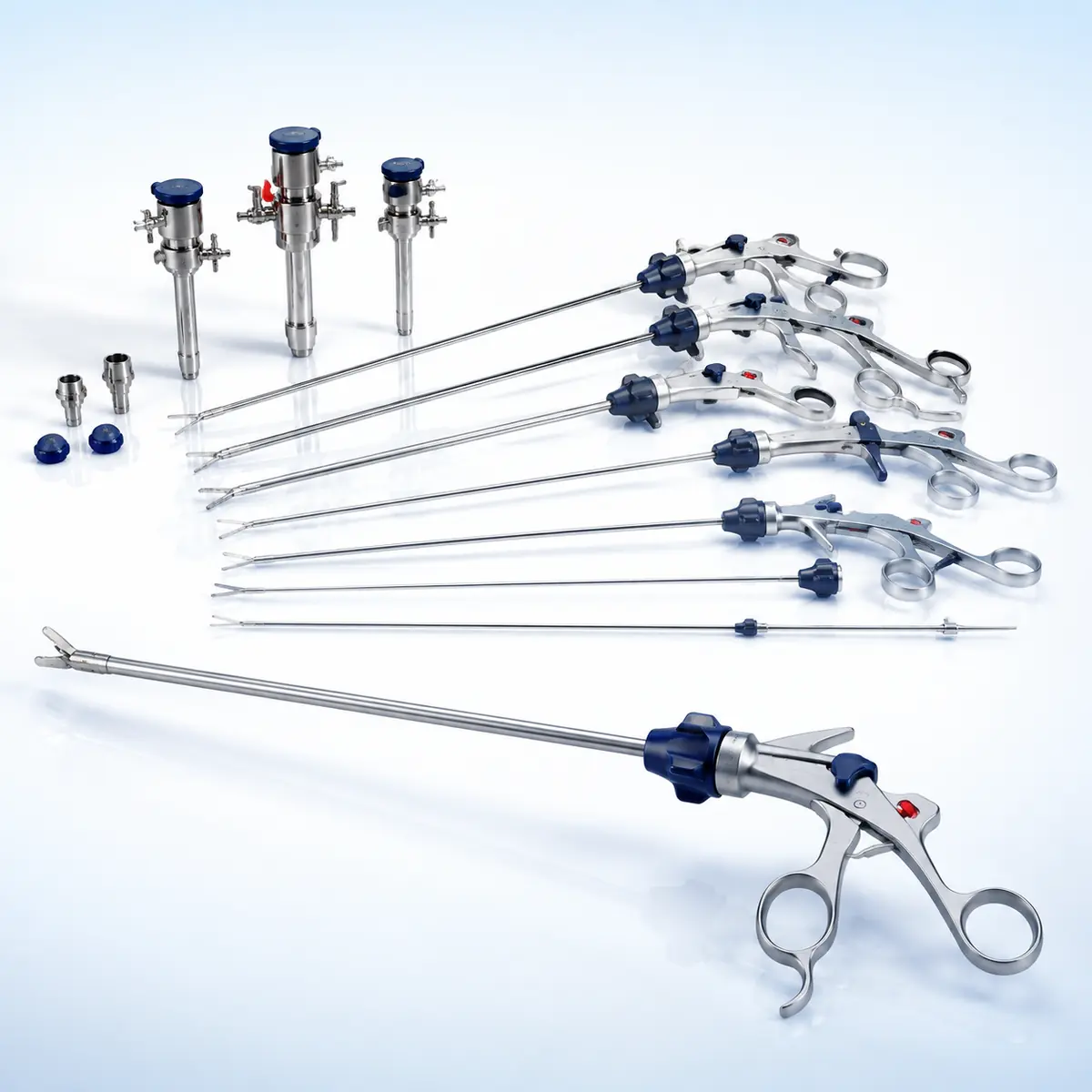
Main Parts of a Laparoscopic Needle Holder

  • Handle: Controls jaw opening and closure. Shape affects grip, wrist rotation, and muscle fatigue.
  • Shaft: Passes through the trocar or access port. Outer diameter and working length must match access parameters.
  • Rotation mechanism: Allows shaft or jaw rotation to angle curved needles without changing the access point.
  • Locking mechanism: A ratchet or toggle that maintains needle grip without continuous hand squeeze.
  • Jaw: Directly grips the needle. Surface pattern (smooth/serrated/carbide inserts) affects slip resistance.
  • Cleaning connection: Luer-lock flushing connection in reusable configurations.

Supplier Selection Standards

Commercial portfolios demonstrate that laparoscopic needle holders are available with different diameters, lengths, handle types, jaw designs and locking configurations.

Industry Reference Standards:

  • Aesculap AdTec range: lists axial handles, multiple sizes/lengths, lock/non-lock options and carbide jaw inserts.
  • KARL STORZ range: lists dismantling status, jaw action (e.g. Parrot-Jaw), ratchets, cleaning ports, and diameters.

* An enquiry that says only “send a laparoscopic needle holder” is incomplete. Specific configuration parameters must be documented.

Detailed Matrix

Which Needle Holder Specifications Matter Most?

Review these parameters before ordering to ensure surgeon and setup compatibility.

Selection Factor What to Confirm Why it Matters
Procedure Type and location of surgery Determines access, reach and required control
Needle Size, curvature and construction Jaw must hold the intended needle appropriately
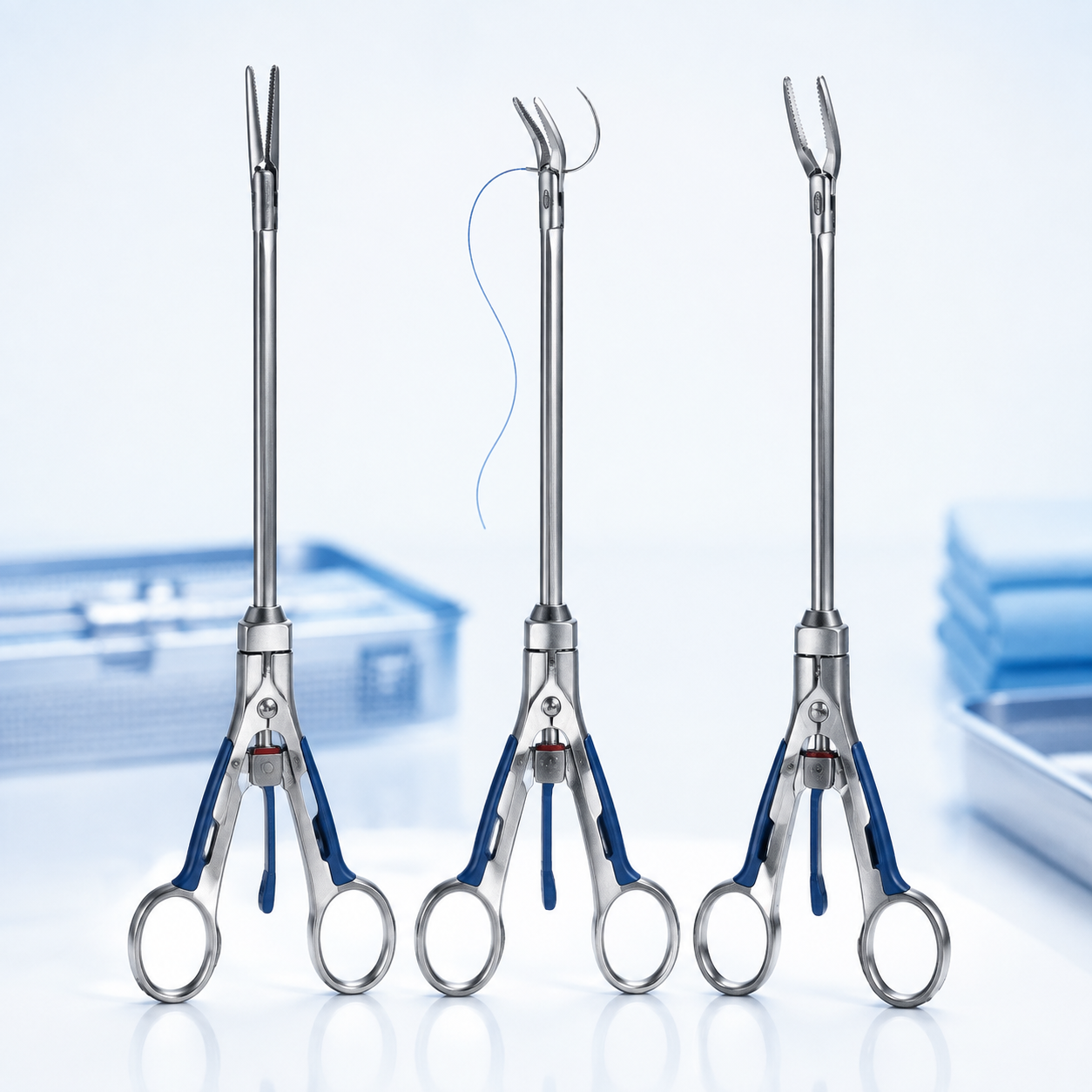
Jaw shape Straight, curved, angled or specialty profile Affects needle positioning and visibility
Jaw direction Left-curved, right-curved or neutral Influences working angle and surgeon preference
Jaw surface Smooth, serrated or insert-based (tungsten carbide) Affects grip stability and potential needle interaction
Shaft diameter Commonly 3 mm or 5 mm Must match the intended access port or trocar cannula
Working length Standard (33 cm) or extended/shorter lengths Must reach the operative field without restricting control
Handle Axial, pistol-grip, ring-style or another design Affects wrist rotation, hand fatigue, and ergonomics
Lock Ratcheted, toggle-style or non-locking Changes how the needle is held and released during passage
Rotation Fixed or rotatable shaft Influences needle orientation inside the operative field
Construction Dismantling or non-dismantling Affects cleaning, assembly, sterilization and maintenance
Intended use Reusable or single-use Determines reprocessing requirements and inventory planning
Selection Process

Step-by-Step Technical Selection

Follow this step framework to match the needle holder to surgical requirements.

Step 1: Start with the Procedure & Needle

The surgical procedure and needle specifications should be defined before selecting the instrument:

  • Identify if the suturing is deep pelvic, gynecological vault closure, bariatric, or routine general surgery.
  • Get the needle length, curvature, cross-section body, material, and suture size.
  • A jaw designed for large needles may slip on fine needles. A delicate jaw might deform under heavy needles.

Step 2: Choose Jaw Shapes & Gripping Interfaces

Match jaw contours and surfaces to the expected suturing angle:

  • Straight jaws: suitable for neutral alignment and direct approaches.
  • Curved jaws (Left/Right/Up/Down): help position needles where port placement makes straight angles awkward.
  • Serrated Jaws & Carbide Inserts: Serrated profiles improve mechanical lock. Tungsten carbide inserts provide a highly durable grip, but insert alignment and repair options must be verified.

Step 3: Select Shaft Diameter & Working Length

Confirm compatibility with access trocars and patient depth:

  • 3 mm / 3.5 mm: selected for mini-laparoscopy or reduced-port procedures.
  • 5 mm: standard diameter for conventional laparoscopy.
  • Working length: standard is approx 33 cm. Ensure it provides adequate reach (shorter or bariatric extended shafts) without causing instrument interference outside the patient.

Step 4: Compare Handles & Locking Mechanisms

Ergonomics and control style affect the surgeon’s comfort:

  • Axial handle: aligns hand with the shaft, supporting easy rotation and needle angling.
  • Pistol-grip & Ring-style handles: provide different wrist positions. Finger ring handles are familiar but comfort depends on lock release pressure.
  • Locking / Ratcheted: maintains jaw closure without continuous hand squeezing.
  • Non-locking: allows direct grip pressure regulation and quick disengagement.

Step 5: Shaft Rotation & Dismantling Status

Operational variables affecting maintenance and use:

  • Rotating vs Fixed shaft: rotating shafts simplify changing jaw angles while suturing, but require additional care around the rotation control.
  • Dismantling: allows separation of handle, insert, and sleeve for clean flushing, but requires correct reassembly.
  • Non-dismantling: reduces assembly steps, but relies entirely on flush-ports for lumen cleanability.
CSSD Guidelines

Needle Holder Reprocessing & Inspection

Reusable needle holders contain internal rods, hinges, joints, and locking springs that demand strict decontamination workflows.

FDA Reprocessing Principles

Reprocessing is a detailed, multi-step process involving cleaning followed by disinfection or sterilization according to manufacturer instructions. (FDA: Reprocessing of Reusable Medical Devices)

Facility check before purchasing:

Verify instructions for use • Disassembly steps • Cleaning parameters • Flushing tools • Permitted detergents • Sterilization cycles • Drying times • Inspection criteria.

Pre-Use Inspection Checklist

Visually and functionally check for:

  • Residual contamination • Stains, pitting, corrosion
  • Bent or damaged shaft • Misaligned jaws
  • Worn jaw surfaces • Loose, chipped inserts
  • Irregular jaw closure • Excessive play at the tip
  • Stiff/rough movement • Faulty ratchet engagement
  • Difficult lock release • Uncontrolled shaft rotation
  • Blocked flushing ports • Missing components

* If an instrument fails inspection, quarantine it immediately for assessment, repair or replacement.

Common Buying Mistakes to Avoid

  • Buying only by photograph: visual checks cannot identify jaw direction or lock stiffness.
  • Ordering only by nominal size: writing “5 mm needle holder” ignores handle, lock, and jaw specifications.
  • Ignoring surgeon handedness: Left vs Right curved jaws create different working directions.
  • Selecting unsuitable jaws: matching jaw geometry to needle Curvature is vital to prevent needle deformation.
  • Failing to confirm reprocessing: Reusable needle holders should not be purchased unless the CSSD can process them as validated.

Needle Holders for Medical Colleges

Training centers require a range of configurations so students can practice multiple suturing styles. A training inventory may include:

  • Straight-jaw needle holders
  • Left-curved and right-curved models
  • Ratcheted and non-ratcheted instruments
  • Axial and pistol-grip/ring handles
  • Standard working lengths (approx 33 cm)
  • Suitable training sutures & endo trainers
  • Backup instruments & replacement spare parts

* Repeated dropping, incorrect needle clamping, and excessive handle squeeze will damage training instruments.

Pre-Purchase Audit

Evaluation Before Bulk Purchase

Where practical, hospitals and training centers should evaluate sample needle holders before standardizing. An evaluation team may include a laparoscopic surgeon, gynecologist/urologist, OR nursing staff, CSSD representative, infection-control team, and biomedical engineers.

Evaluation criteria should cover:

  • Needle acquisition • Grip stability • Needle rotation
  • Jaw visibility • Ease of release • Handle comfort
  • Lock operation • Instrument balance • Shaft rotation
  • Port compatibility • Cleanability • Assembly steps

* Results should be recorded against the exact product code to prevent unapproved substitution during procurement.

Information to Include in Your RFQ

Please supply the following parameters:

  • Hospital, clinic or company name • Delivery PIN code
  • Surgical specialty • Intended procedure
  • Required jaw pattern • Left, right or straight orientation
  • Needle type and size (if known)
  • Shaft diameter • Working length
  • Handle type • Ratcheted or non-ratcheted requirement
  • Rotating or fixed shaft preference
  • Reusable or disposable requirement • Dismantling preference
  • Required quantity • Target delivery date
  • Required documentation • Sample requirement

* If specifications are unknown, send a photograph of the current needle holder together with its product markings and dimensions.

Quality Checked Needle Holders
Manufacturing Excellence

Suturing Instruments from Bharat Surgical

Bharat Surgical manufactures and supplies reusable laparoscopic needle holders in multiple configurations. Available specs should be verified against procedure requirements before purchase.

ISO 13485:2016 Certified Quality Management System
ISO Registration Number: RQMD91/11579 (Expiry: 11 Sept 2027)

CE Certificate No. 9277
Stated Scope: Manufacture of laparoscopy, urology, ophthalmic, gynecology, neuro,ENT, orthopaedic and general surgery instruments. (Expiry: 15 April 2028)

GSTIN Registration: 27ADFPA5321C1ZA (Maharashtra)

CE applicability and supporting documents must be confirmed for the specific needle holder model being quoted. (Internal link: Explore Laparoscopic Needle Holders)

Got Questions?

Frequently Asked Questions

Find immediate answers to common operational questions regarding laparoscopic needle holders.

Choose the shaft diameter and working length according to the trocar, procedure, patient anatomy and operating setup. A 5 mm diameter and approximately 33 cm working length are commonly available, but they are not suitable for every requirement.

Neither is universally better. Straight jaws provide neutral alignment, while curved jaws may support particular approach angles and needle orientations.

It is a needle holder whose distal jaw profile curves toward a specified side. Because naming conventions can differ, confirm the direction through a technical drawing, product code or sample.

Some surgeons prefer complementary left- and right-curved instruments for different suturing angles or two-handed techniques. The requirement depends on the procedure and surgeon preference.

An axial-handle instrument positions the operating handle generally along the shaft’s axis. This configuration may assist rotation and needle orientation, depending on its design.

It may be comfortable for some surgeons, but suitability depends on hand size, technique, procedure duration and preferred wrist position. Sample evaluation is recommended.

Choose a ratcheted model if the surgeon wants the instrument to maintain a selected grip. A non-ratcheted model may be preferred when continuous pressure control and rapid release are important.

It is a specialty design intended to assist with positioning a needle relative to the instrument shaft. Its effectiveness and needle compatibility should be assessed for the intended technique.

Not for every requirement. Tungsten carbide inserts may provide a durable gripping surface, but jaw design, needle compatibility, alignment and instrument condition remain important.

A general grasper is not automatically a suitable substitute. Needle holders are specifically designed for controlled needle manipulation. Use only an instrument appropriate for the intended purpose.

Approximately 33 cm is commonly available for standard laparoscopy. Shorter or extended lengths may be required for particular procedures or patient anatomy.

Do not assume universal compatibility. Confirm the instrument’s actual dimensions, jaw closure profile, cannula bore and seal design.

Provide the supplier with the exact needle, suture and procedure details. A finer jaw and controlled closing action may be considered, but the instrument manufacturer’s supported use should be verified.

Usually not optimally. Jaw geometry and grip characteristics may be better suited to particular needle ranges. Confirm compatibility before standardization.

Not necessarily. Check the product label and instructions. Many reusable surgical instruments require processing before their first clinical use and reprocessing after every subsequent use.

Follow the exact manufacturer’s instructions for point-of-use handling, disassembly, flushing, cleaning, rinsing, drying, inspection, packaging and sterilization.

Remove it from use if it has misaligned jaws, poor grip, damaged inserts, a bent shaft, corrosion, irregular movement or a faulty locking mechanism. An authorized assessment should determine whether repair is appropriate.

A training center may require straight and curved jaws, different handle types, ratcheted and non-ratcheted models, an endo trainer, suitable training sutures and adequate backup instruments.

Bharat Surgical supplies laparoscopic needle holders in available configurations. Jaw pattern, diameter, length, handle, locking mechanism, quantity and delivery requirements should be confirmed during enquiry.

Send the procedure, jaw shape, orientation, shaft diameter, working length, handle style, locking requirement, reusable or disposable preference, quantity and delivery location.

Request a Laparoscopic Needle Holder Quotation

Send Bharat Surgical the required jaw shape, orientation, handle style, lock, quantity, reference photograph and delivery details.

Chat on WhatsApp