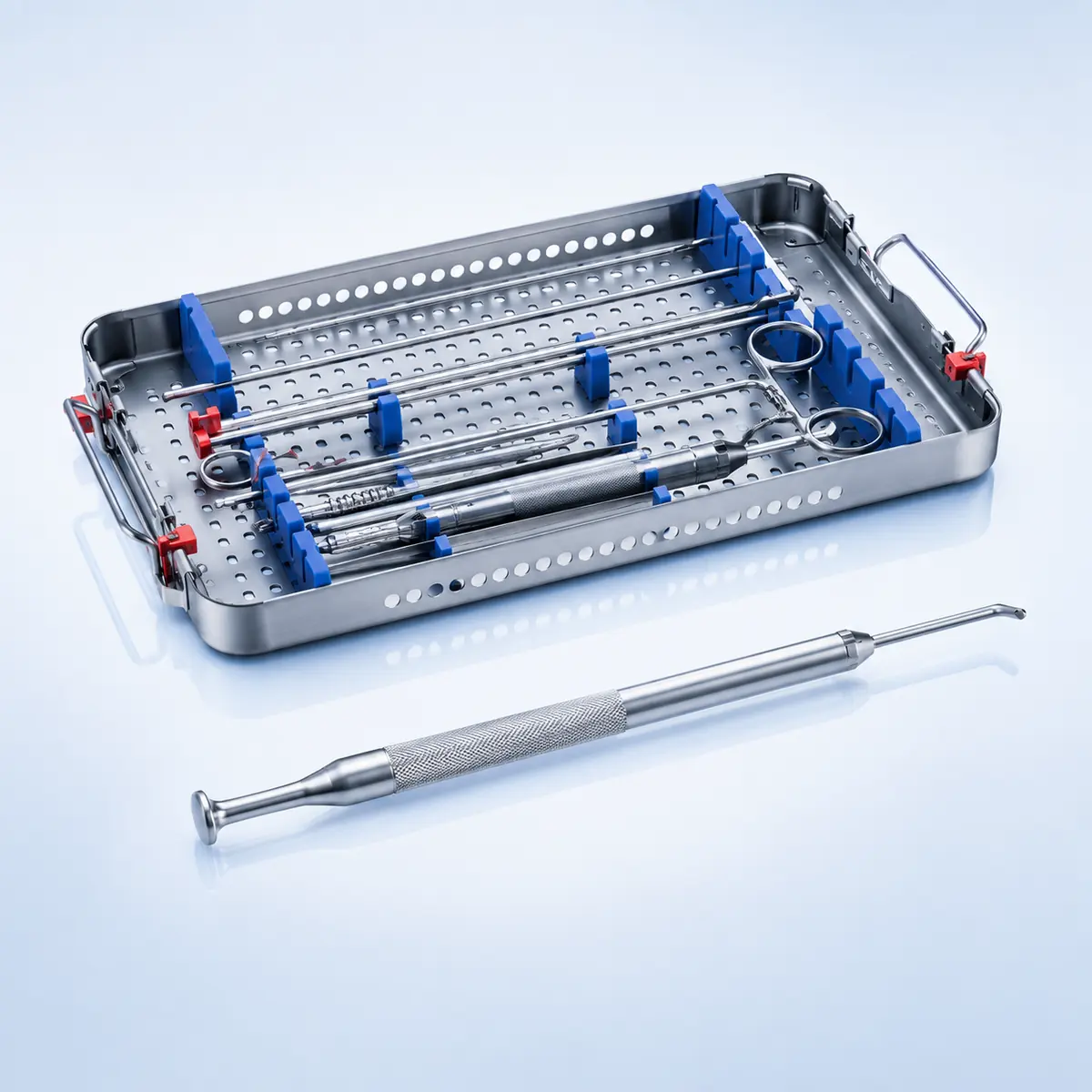
Bharat Surgical manufactures and supplies reusable laparoscopic knot pushers in 5 mm stainless-steel configurations for hospital, surgical-centre and laparoscopic training requirements. Published options include a standard 5 mm knot pusher, Clark knot pusher and knot pusher with reducer. A detailed Bharat Surgical listing identifies a 5 mm diameter, 300 mm length, non-electrosurgical construction and stainless-steel grade 304. Exact distal-tip design, reducer configuration and sterilization parameters should be confirmed for the selected product code.
A laparoscopic knot pusher is a long-shaft instrument designed to guide and advance a suture knot along the suture during minimally invasive suturing.
The distal end engages or guides the suture, while the shaft allows the knot to be advanced through a laparoscopic access port. Different tip configurations may be selected for sliding knots, slip knots, half hitches or other surgeon-approved suturing requirements.
| Product variant | Published information | Availability note |
|---|---|---|
| Standard Laparoscopic Knot Pusher | 5 mm diameter, 300 mm length, reusable stainless-steel construction | Published in the laparoscopic instrument range |
| Clark Knot Pusher | 5 mm, stainless steel, grade 304 listed | Distal-tip dimensions must be confirmed |
| Knot Pusher with Reducer | Multiple sizes mentioned; reducer included or integrated according to selected configuration | Exact reducer sizes are not published |
| Knot Pusher with Cutter | Listed in Bharat Surgical’s product navigation | Technical specifications and current availability must be confirmed |
Bharat Surgical describes its standard laparoscopic knot pusher as a reusable 5 mm × 300 mm instrument. A separate Clark knot pusher listing identifies stainless-steel construction and grade 304.
| Specification | Published information |
|---|---|
| Product type | Laparoscopic Knot Pusher |
| Diameter | 5 mm |
| Length | 300 mm |
| Material | Stainless steel |
| Published material grade | SS 304 |
| Usage type | Reusable |
| Working type | Non-electrosurgical |
| Application | Laparoscopic and hospital use |
| Finish | Polished on the detailed range description |
| Available named variants | Standard, Clark and with-reducer |
| Cutter option | Listed, but specifications unconfirmed |
| Sterilization description | Autoclavable |
| Sterile supply status | Confirm before ordering |
| Brand | Bharat Surgical |
| Country of origin | India |
| Minimum published quantity | Varies by listing and commercial channel |
One marketplace field incorrectly classifies the knot pusher as a trocar. The correct product type is laparoscopic knot pusher, and it should be listed separately from trocars in the website, catalogue and hospital BOQ.
The distal-tip profile is one of the most important selection criteria.
Common distinctions may include:
Bharat Surgical’s online listings do not provide dimensioned images for every tip. Buyers should request a close-up photograph or technical drawing before approving the model.
| Selection factor | Standard Knot Pusher | Clark Knot Pusher |
|---|---|---|
| Published diameter | 5 mm | 5 mm |
| Published length | 300 mm | Confirm |
| Material | Stainless steel | Stainless steel |
| Material grade | SS 304 listed | SS 304 listed |
| Distal-tip design | Model-specific | Clark-style tip |
| Reusability | Reusable | Confirm for current model |
| Electrical function | Non-electrosurgical | No electrical connection listed |
| Selection basis | Tip, length, suture and surgeon preference | Clark-tip requirement and surgeon preference |
The term “Clark” refers to a specific knot-pusher style. It should not be treated as a different surgical procedure or as automatically suitable for every suture and knot type.
Bharat Surgical separately lists a laparoscopic knot pusher with reducer. This configuration may be useful when a smaller instrument must be introduced through a larger access port while maintaining the required port interface.
Before ordering, confirm:
The knot pusher with reducer listing states that different sizes are available but does not publish exact size combinations.
A knot pusher with cutter combines knot-guiding and suture-cutting functions in one instrument assembly. Bharat Surgical currently lists this product name but does not provide enough technical information to make performance or compatibility claims.
Hospitals should verify:
Do not describe a cutter model as available for procurement until its current product code and specifications are confirmed.
The published 5 mm model is intended to be evaluated with a compatible laparoscopic access port.
Confirm:
A nominal 5 mm diameter does not guarantee passage through every 5 mm trocar because valve design, manufacturing tolerance and the maximum distal-tip diameter can differ.
| Feature | Knot Pusher | Laparoscopic Needle Holder |
|---|---|---|
| Distal mechanism | Suture-guiding or knot-pushing tip | Opening and closing jaws |
| Primary product function | Advances or positions a prepared knot | Holds and controls a suturing needle |
| Handle | Fixed or model-specific grip | Jaw-actuating handle |
| Published diameter | 5 mm | Model-specific |
| Electrical function | Non-electrosurgical | Usually non-electrosurgical unless otherwise specified |
| Interchangeability | Cannot replace a needle holder | Cannot replace a knot pusher |
These instruments are complementary components of a laparoscopic suturing set and should be specified separately.
| Feature | Knot Pusher | Trocar Reducer |
|---|---|---|
| Product type | Surgical hand instrument | Port-sizing accessory |
| Primary function | Guides and advances suture knots | Adapts a larger port for a smaller instrument |
| Distal end | Knot-guiding tip | Instrument passage opening |
| Shaft | Long laparoscopic shaft | Short port-mounted component |
| Combination option | May be supplied with a reducer | Can be supplied separately |
| Procurement | Specify tip, diameter and length | Specify incoming and outgoing port sizes |
The reducer supplied with a knot pusher should not automatically be considered compatible with every trocar system.
Before requesting a quotation, identify:
Procurement Notice: The final product selection must be approved by qualified surgeons and the hospital’s technical procurement team.
| Item to verify | Information required | |
|---|---|---|
| Knot pusher | Diameter, length and distal-tip style | |
| Trocar | Internal diameter and valve construction | |
| Reducer | Entry diameter, exit diameter and attachment | |
| Suture | Type and size range approved for the selected model | |
| Needle holder | Shaft length and handle style for the suturing set | |
| Scissors | Separate or integrated cutting requirement | |
| Reprocessing | Validated cleaning and sterilization process | |
| Documentation | Technical sheet, IFU and material details | |
| Packaging | Tip protection and product identification |
The selected knot pusher should be evaluated for the sutures used by the hospital. Request written information covering:
Avoid claims that one knot pusher works with all sutures or every knot configuration.
Check:
A rough or burred suture-contact surface can damage the suture. Instruments with damaged tips, bent shafts, loose components or corrosion should be removed from service.
Reusable knot pushers must be processed according to their product-specific instructions.
General considerations include:
“Autoclavable” does not define the complete cycle. Obtain the validated temperature, pressure, exposure time, drying and packaging requirements.
Bharat Surgical can support enquiries for:
Hospitals should request tip photographs, dimensions and suture compatibility before technical approval.
A knot pusher may be included in laparoscopic suturing and endo trainer sets. Bharat Surgical’s published Endo Trainer Kit includes a needle holder and knot pusher with reducer among its listed components.
Training-centre buyers should confirm:
Training suitability should be determined by the institution’s faculty and curriculum requirements.
Dealers and distributors can enquire about:
All commercial and technical terms should be confirmed in the quotation.
"Reusable laparoscopic knot pusher, 5 mm diameter, 300 mm length, non-electrosurgical, stainless-steel construction, polished finish, [standard/Clark] distal-tip profile, compatible with specified laparoscopic access port, supplied with product-specific IFU and technical documentation."
For a reducer-equipped model, add the required input and output diameters. For a cutter model, add the approved suture range, cutter mechanism and service requirements.
Exact specifications and availability must be confirmed against the selected product code.
Find technical, reprocessing, ordering, and size compatibility answers for the Bharat Surgical Knot Pusher range.
It is a long-shaft instrument designed to guide and advance a suture knot during minimally invasive suturing.
A reusable 5 mm model is published in the laparoscopic instrument range.
The detailed standard knot-pusher listing states a length of 300 mm.
The published instrument is manufactured from stainless steel.
Bharat Surgical’s detailed listings identify grade 304 for the standard and Clark knot pushers.
Yes. The standard detailed model is described as reusable.
No. The standard product is listed as non-electrosurgical.
Yes. Bharat Surgical separately lists a 5 mm Clark knot pusher.
It is a knot-pusher configuration with a particular distal-tip style. Exact tip dimensions should be confirmed from the selected model.
Yes. Bharat Surgical publishes a knot-pusher-with-reducer option.
The current listing states that different sizes may be offered but does not specify exact combinations. Confirm the required input and output diameters.
The product is listed in Bharat Surgical’s range, but current specifications and availability should be confirmed before ordering.
The main difference is the distal-tip design. Request close-up images and dimensions to compare the selected models.
No. A needle holder controls the suturing needle, while a knot pusher guides or advances the knot.
No. The knot pusher is a hand instrument. A reducer adapts the port opening for a smaller instrument.
Not automatically. Confirm maximum external diameter, distal-tip dimensions and trocar-valve compatibility.
It may be used with a compatible reducer, subject to the approved trocar, reducer and instrument combination.
Reducer inclusion is quotation-specific. Request written confirmation.
The published listings do not state a complete suture range. Provide the suture types and sizes used by the hospital for compatibility confirmation.
No universal compatibility should be assumed. Selection depends on the tip design, suture and surgeon-approved knot technique.
Check for deformation, roughness, burrs, damaged slots, retained contamination and other visible defects.
It should be removed from service because a rough suture-contact surface may damage the suture.
Follow its IFU and hospital CSSD procedure, paying particular attention to distal notches, slots, eyes and detachable components.
It is described as autoclavable, but the complete validated cycle must be obtained from the product-specific IFU.
Only if permitted by the current product instructions.
Yes. Knot pushers can be requested separately or as part of an endo trainer instrument requirement.
Hospitals, dealers and distributors can request quantity-based quotations.
A sample may be requested for technical evaluation, subject to availability and commercial policy.
Provide the tip style, shaft diameter, length, reducer requirement, cutter requirement, suture sizes, quantity and delivery location.
Request the product code, technical sheet, tip drawing, material confirmation, IFU, reprocessing information and current quotation.
Knot Pusher pricing varies according to technical specifications, quantity, packaging, and delivery destination. Send your configuration details to receive a current B2B quotation.
Factors Affecting Price: Standard or Clark model, Tip geometry, Shaft diameter, Working length, Stainless-steel grade, Reducer inclusion, Reducer size combination, Cutter mechanism, Reusable construction, Documentation requirement, Order quantity, Packaging, Domestic or export delivery, Taxes and freight