ISO 13485:2016 Certified
40+ Years of Excellence
600+ Products
Download Catalog
BUYER GUIDE | LAPAROSCOPIC SIMULATION

Endo Trainer Buying Guide for Medical Colleges

A medical college should choose an endo trainer according to its curriculum, number of learners, camera system, task modules, instrument compatibility, recording requirement, durability, consumable cost and after-sales support.

For most undergraduate, postgraduate and basic laparoscopic-skills laboratories, a well-designed camera-based box trainer can support repeated practice in hand–eye coordination, depth interpretation, object transfer, cutting and suturing.

ISO 13485:2016 Certified
CE Certified Quality
Laparoscopic Skills Laboratory
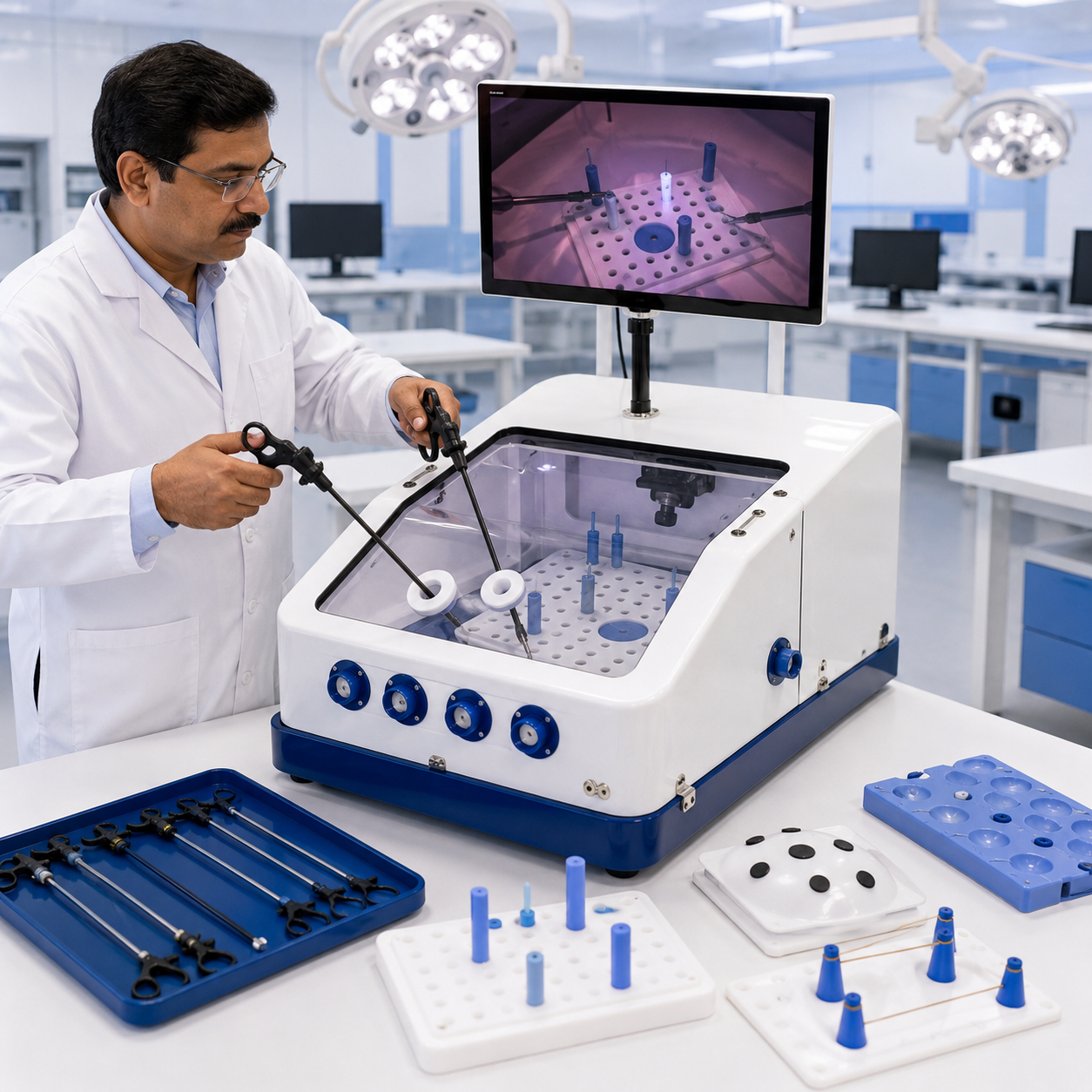
Gynecology Instruments surgical instrument on a clean clinical blue background
Pre-Order Verification

Quick Endo Trainer Buying Checklist

Confirm these requirements before requesting a quotation for skills laboratory equipment.

  • ☐ Trainee target group: Undergraduate, postgraduate or surgical residents
  • ☐ Procedure specialty: General surgery, gynecology, urology or multidisciplinary
  • ☐ Batch sizes and number of simultaneous training stations required
  • ☐ Setup profile: Portable box trainer or permanent skills laboratory
  • ☐ Camera: Built-in integrated camera or external telescope setup
  • ☐ Camera specs: Image resolution, frame rate (latency), and focus range
  • ☐ Display: Built-in monitor, external display output, or computer/tablet sync
  • ☐ Internal lighting arrangement and glare protection
  • ☐ Access ports: Number, spacing, diameters, and grommet replacement
  • ☐ Practice modules: Peg-transfer, precision-cutting, suturing, loop ligation
  • ☐ Consumables: Replaceable suturing pads, foam blocks, tubes, sutures, clips
  • ☐ Video recording and storage for faculty assessment and review
  • ☐ Included instruments: Graspers, scissors, needle holders, knot pushers
  • ☐ Warranty terms covering the camera, light, monitor, and instruments
  • ☐ Installation, faculty orientation, and ongoing repair service support
  • ☐ Budget allocations and delivery schedule expectations

The trainer alone does not establish clinical competence. It should be used within a faculty-supervised curriculum.

Syllabus Objectives

What Skills Can Be Practised?

A box trainer is designed to develop basic laparoscopic psychomotor skills and hand-eye coordination.

Manual Dexterity Tasks

Laparoscopy involves an indirect view and longer instruments, requiring practice in:

  • Hand–eye coordination and bimanual instrument manipulation
  • Depth interpretation and tactile feedback limitation
  • Peg transfer (object grasping and transfer between hands)
  • Precision cutting along defined templates
  • Ligating loop application and knot-pusher advancement

Suturing & Knot Tying

Advanced skill development requires practice in:

  • Needle handling and loading at different angles
  • Intracorporeal suturing and knot formation
  • Extracorporeal knot tying under visual guidance
  • Anatomical model dissection (appendectomy/cholecystectomy models)
  • Camera assistant navigation and alignment coordination

The FLS manual-skills component uses five non-procedure-specific tasks. A trainer should not be described as an official FLS testing system unless approved.

Design Categories

Main Types of Endo Trainers

Trainer Type Suitable For Main Consideration
Basic box trainerEntry-level practice and demonstrationsCamera and display may need to be added separately
Camera-based trainerStructured skills-lab practiceCheck image quality and latency (video delay)
Portable endo trainerIndividual or shared practice across departmentsDurability, assembly, and setup time
Full-stack compatible trainerRealistic camera, telescope and light-cable practiceRequires real endoscope equipment and stack space
Recording-enabled trainerFaculty review, scoring and assessmentStorage, privacy and file management
Procedure-specific trainerAdvanced simulation using anatomical modelsModel and consumable availability and cost
Virtual-reality simulatorDigital tasks, metrics and scenariosHigher purchase, licensing and maintenance cost

Basic Box vs Integrated Camera Trainer

Basic Box Trainer:

An enclosed chamber with instrument ports and a platform. Usually relies on a smartphone, webcam, or tablet. Suitable for low budgets or portable student programs, but has image consistency and recording limits.

Integrated Camera Trainer:

Includes an internal camera and LED lighting. Key factors to evaluate include resolution, frame rate, focus range, field of view, light uniformity, and glare. Low latency is more important than raw high resolution.

Full-Stack Compatible vs VR Simulators

Full-Stack Compatible Trainer:

Allows trainees to practice using a real laparoscope, camera head, light cable, and light source. Supports telescope handling, camera assistant training, and focus control. Requires more space and budget.

Virtual-Reality Simulators:

Uses digital environments, software scenarios, and automated performance tracking. Involves higher initial purchase, software licenses, and hardware maintenance, but has fewer physical consumables.

Comparative Analysis

Box Trainer vs Virtual-Reality Simulator

Factor Box Trainer Virtual-Reality Simulator
Physical instrumentsUses actual or training laparoscopic instrumentsUses specialized simulator controls
Tissue modelsPhysical task modules (suturing pads, pegboards)Digitally simulated graphics
Purchase costUsually lower and highly scalableGenerally higher initial capital cost
ConsumablesRequires pads, sutures, loops and task materialsUsually fewer physical consumables
Automated metricsLimited unless software is includedOften built-in tracking
Faculty scoringCommonly required for reviewMay include automatic scoring rubrics
PortabilityOften highly portable and stackableUsually less portable and sensitive
Real instrument handlingIdentical weight, tactile grip, and linkage feedbackVaries based on simulator hardware

Enclosure, Camera & Lighting Specifications

Chamber and Access Ports:

Evaluate the internal space (width, depth, height), stability, material, and cleaning practicality. Ports should support 5 mm and 10 mm instruments, incorporate replaceable seals, and offer variable angles to suit left- or right-handed layouts.

Internal LED Lighting:

LED lighting must be even, dimmable, and prevent excessive reflection on glossy suturing pads or metal instrument shafts. Dimmable setups allow adjustments to reduce glare.

Display, Recording & Instruments

Monitor & Recording:

Confirm the screen size, input type (USB, HDMI), and whether the system can record full training sessions, export standard MP4 files, and add trainee identifications. The skills lab layout should place monitors at approximately eye level.

Included Laparoscopic Instruments:

A typical set includes two atraumatic graspers, a Maryland dissector, laparoscopic scissors, a needle holder, and a knot pusher. Training instruments must be durable to withstand drops or excessive force.

Curriculum Integration

Task Modules, Consumables & Lab Planning

Curriculum, tasks, and repetitive practice schedules are more important than hardware alone.

Essential Basic Task Modules

  • Peg-transfer module: Bimanual coordination, depth interpretation, and object transfer.
  • Precision-cutting module: Pattern holders and replaceable printed template gauze.
  • Loop-ligation module: Placement of pre-tied loops around simulated structures.
  • Intracorporeal suturing module: Needle handling and knot formation on a suturing pad.
  • Extracorporeal knot-tying module: Knot tying outside and advancing with a knot pusher.
  • Advanced modules: Ovarian cyst, appendectomy, cholecystectomy, or reconstruction models.

Consumables & Lab Planning

Recurring consumable costs:

Pads, foam blocks, latex tubes, printed templates, sutures, loops, clips, and port grommets. Evaluate whether consumables are proprietary or locally replaceable, and confirm lead times.

Skills-Lab Planning & Quantity:

Skills labs require height-adjustable tables, monitor stands, cable routing, storage, and cleaning areas. Planning formula: Training stations = learners simultaneously practising ÷ learners allocated per trainer (commonly 2 per station).

Manufacturing Excellence

Endo Trainers from Bharat Surgical

Bharat Surgical supplies endo trainers and laparoscopic training instruments for medical colleges, teaching hospitals, simulation laboratories, training institutes and surgical departments.

Exact camera, display, recording, module and instrument specifications should be confirmed in the quotation.

ISO 13485:2016 Certified Quality Management System
ISO Registration Number: RQMD91/11579 (Expiry: 11 Sept 2027)

CE Certificate No. 9277
Scope: Manufacture of laparoscopy, urology, ophthalmic, gynecology, neuro, ENT, orthopaedic and general surgery instruments. (Expiry: 15 April 2028)

GSTIN: 27ADFPA5321C1ZA (Maharashtra)

Unless separately documented, a Bharat Surgical endo trainer should not be represented as an official FLS assessment or certification system.

Buyer’s RFQ Checklist

Include the following in your enquiry:

  • College or institution name • Department
  • Training level (undergrad/postgrad/residents)
  • Number of learners per batch • Required stations
  • Portable or fixed box trainer • Carrying cases
  • Camera: Built-in or external • Latency specification
  • Monitor requirement • Video recording/export capability
  • Required access ports • Task modules (list items)
  • Specialty-specific models (cholecystectomy/suturing)
  • Laparoscopic instruments (types and quantity)
  • Consumable pack quantities • GST and delivery location
  • Warranty, installation, and faculty orientation
  • Annual maintenance contract (AMC) requirement
Got Questions?

Frequently Asked Questions

Quick answers to common questions about endo trainers and skills lab equipment.

An endo trainer is a simulation box used to practise laparoscopic instrument skills while viewing the task through a camera and monitor.

Yes. The terms are commonly used for the same general type of physical laparoscopic simulation device.

Tasks may include peg transfer, object handling, precision cutting, loop ligation, needle handling and intracorporeal or extracorporeal knot tying.

It may support introductory hand–eye coordination and instrument-orientation sessions when used under an appropriate curriculum.

Yes, if the trainer includes suitable ports, needle holders, suturing pads and task space.

No. A box trainer supports simulation practice and assessment. It does not independently establish readiness for unsupervised clinical procedures.

Choose a resolution that provides a clear image, but also evaluate latency, focus, field of view, lighting and display compatibility.

A built-in camera simplifies setup. An external laparoscopic camera may better support camera-navigation and stack-equipment training.

It may include a monitor or connect to an available laptop, tablet or display. The college should choose according to station layout and learner numbers.

A basic set may include two graspers, scissors, a Maryland dissector, needle holder and knot pusher.

The trainer should have enough suitably positioned ports for bimanual practice, camera placement and the planned specialty modules.

Divide the number of simultaneous learners by the planned number of learners per station, then consider a demonstration or backup trainer.

Common consumables include suturing pads, cutting sheets, sutures, loops, clips, simulated tissue and replacement task objects.

Yes, if its ports, working space, instruments and interchangeable task modules support the needs of each department.

A box trainer uses physical instruments and task materials. A VR simulator uses digital environments and may provide automated performance data.

Some trainers support recording through a computer, integrated recorder or video output. Confirm file format, storage and data-management requirements.

No. Official FLS testing requires the programme’s approved equipment, accessories and procedures.

Request written coverage for the trainer body, camera, lights, display, adapters and supplied instruments, along with service turnaround.

Bharat Surgical supplies available endo trainers, task modules and laparoscopic training instruments for medical institutions.

Provide learner numbers, stations, camera and display requirements, instrument list, task modules, recording, consumables, warranty and delivery location.

Request an Endo Trainer Quotation

Share your learner count, required training stations, task modules, camera and monitor requirements and instrument list with Bharat Surgical.