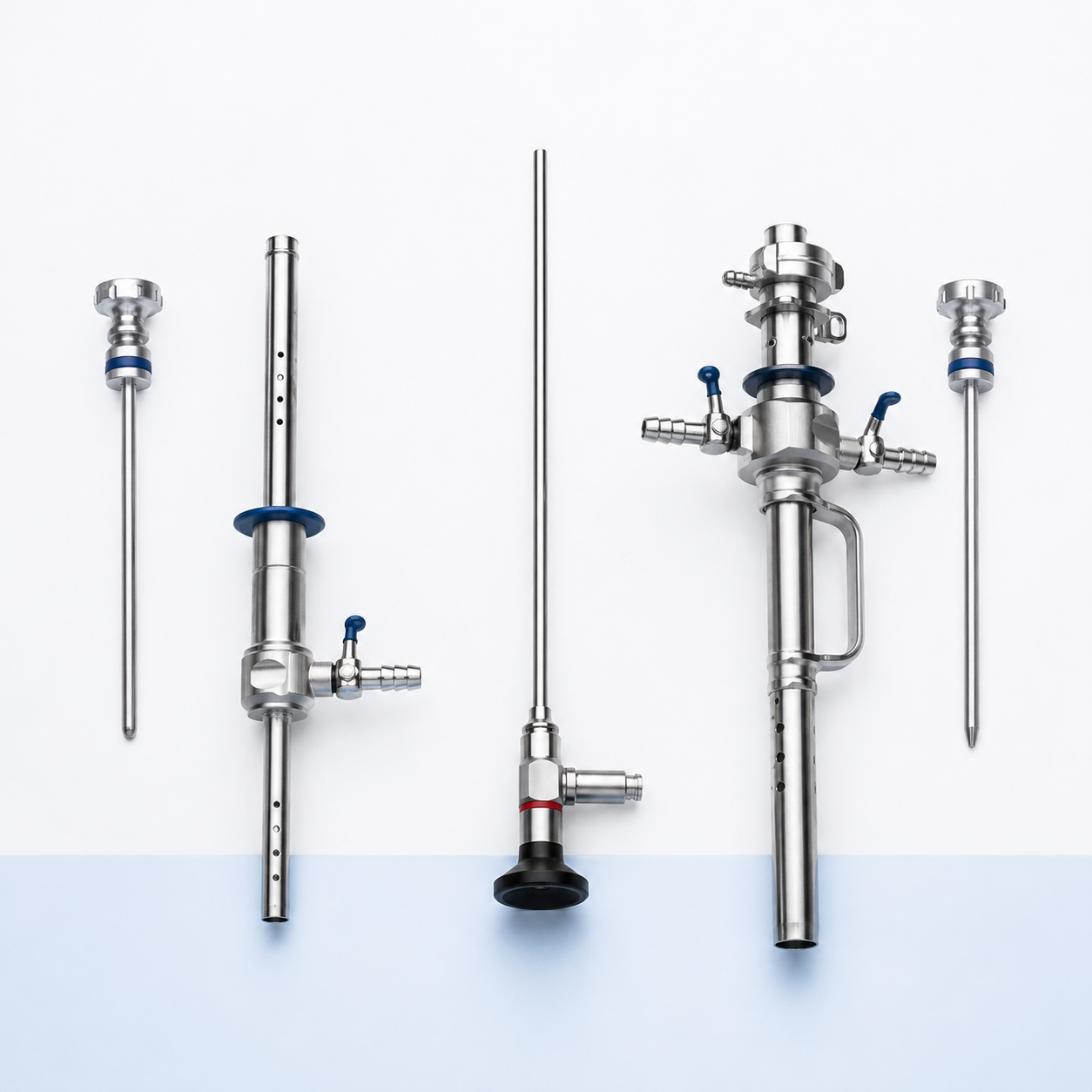
A diagnostic hysteroscopy sheath is primarily intended to support visual examination of the cervical canal and uterine cavity. An operative hysteroscopy sheath includes or supports a working channel through which compatible instruments can be introduced for biopsy or treatment.
The right choice depends on whether the planned procedure requires visualization only, biopsy, foreign-body retrieval, adhesiolysis, polyp treatment or another operative intervention. Buyers must confirm telescope size, direction of view, working-channel size, flow arrangement and instrument compatibility.
These are general differences. Product names are not standardized across all manufacturers, so the exact specification must be checked.
| Factor | Diagnostic Sheath | Operative Sheath |
|---|---|---|
| Primary purpose | Examination and visualization | Visualization plus instrument access |
| Working channel | May be absent or limited, depending on system | Normally includes a defined working channel |
| Outer diameter | Generally smaller | Usually larger |
| Compatible instruments | None or limited diagnostic/biopsy accessories | Graspers, scissors, biopsy forceps, electrodes or system-specific devices |
| Fluid flow | Single-flow or continuous-flow options may be available | Often designed for continuous inflow and outflow |
| Cervical access | Smaller profile may support easier access | May require greater cervical accommodation |
| Common setting | Diagnostic or office hysteroscopy | Office or operating-room procedures, depending on system |
| Procedure time | Generally intended for examination or limited intervention | Designed to support planned operative work |
| Equipment required | Telescope, light, camera and fluid source | Telescope, instruments, fluid management and sometimes an energy system |
| Procurement priority | Small profile and visualization | Working-channel and instrument compatibility |
A hysteroscopy sheath is the outer component used with a compatible telescope to provide access to the cervical canal and uterine cavity.
Mainly used to permit visualization of the cervical canal and uterine cavity. It supports evaluation of:
Diagnostic Sheath Characteristics:
Some compact examination sheaths allow biopsy or limited instrument passage. Confirm the actual channel and accessory specification.
Designed to support visualization while allowing compatible instruments to pass through a working channel. Compatible instruments include:
The presence of a working channel does not mean every instrument will fit. Channel size, working length, valve, seal and system compatibility must all be checked.
Outer diameter measurements:
Diagnostic sheaths are smaller. Operative sheaths require additional internal space. Compare actual measurements in millimeters or French gauge (1 Fr ≈ 1/3 mm) rather than relying only on labels.
Working channel verification:
Flow arrangements:
Sheaths may provide inflow only, outflow only, combined inflow/outflow, or continuous flow through nested inner and outer sheaths. Continuous flow circulates distension fluid, helping to maintain visibility by clearing blood or debris.
Sheath components list:
An operative continuous-flow system may include an inner sheath, outer sheath, telescope, obturator, stopcocks, instrument port, sealing cap, and inflow/outflow connectors. Every component must be identified by product code to prevent incomplete ordering.
Yes. Some modern compact diagnostic or office hysteroscopy systems include a small working channel for biopsy or minor operative instruments. Compare the actual working-channel size, compatible instruments, flow design, outer diameter and permitted procedures. A diagnostic sheath with a limited biopsy channel should not be assumed capable of supporting every operative hysteroscopy instrument.
Some systems use the same telescope with separate diagnostic and operative sheaths. Before ordering, confirm telescope model/diameter, direction of view (e.g. 0°, 12°, 30°), diagnostic/operative sheath codes, locking interface, obturators, stopcocks, instruments and fluid tubing. Do not assume two sheaths are interchangeable because telescope diameters appear similar.
Compact operative hysteroscope:
Designed to accept small semirigid instruments such as 5 Fr scissors, graspers, biopsy forceps, or small bipolar electrodes.
Resectoscope system:
A larger operative platform containing a working element, inner/outer sheaths, obturators, electrodes and continuous flow pathways. A 5 Fr instrument is not compatible with a resectoscope, and a resectoscope electrode cannot be passed through a compact working channel.
When a diagnostic sheath may be preferred:
Examination only • Smaller insertion profile is preferred • No operative instrument expected • Office or outpatient setting • Simpler assembly and reprocessing.
When an operative sheath may be preferred:
Biopsy planned • Adhesions may be divided • Polyps or foreign bodies retrieved • Scissors or graspers needed • Bipolar electrode introduced • Continuous inflow/outflow needed.
Single-flow sheath:
Uses one pathway for introducing distension fluid. Fluid exits through another route or during instrument withdrawal, depending on the system and procedure.
Continuous-flow sheath:
Provides dedicated inflow and outflow pathways to circulate fluid, remove blood or debris, and stabilize visualization during operative procedures.
Fluid management is important during both diagnostic and operative hysteroscopy. The setup may need to monitor:
Potential fluid-related risks include excessive absorption, fluid overload, and electrolyte disturbance. Clinical teams must follow the selected equipment instructions, guidelines and hospital protocols.
Telescope details:
Confirm diameter, length, direction of view, light-post arrangement, camera connection, locking interface and sterilization compatibility. A matching diameter does not prove a telescope will lock or align correctly.
Working-instrument details:
For operative sheaths, confirm French size/diameter, working length, flexible/semirigid build, handle dimensions, distal jaw opening, channel valve compatibility, and reusable/disposable status. If an instrument passes through but cannot open or rotate correctly, it is not functionally compatible.
Energy compatibility:
Some operative sheaths accept bipolar electrodes. Confirm electrode type/size, generator make/model, cable, connector, permitted fluid medium and telescope compatibility. Do not use an electrosurgical instrument simply because it physically fits.
Reusable sheaths vs disposable sheaths:
Reusable sheaths require disassembly, manual or automated cleaning, channel brushing/flushing, and sterilization. Disposable sheaths reduce reprocessing steps but create recurring purchase, stock management, storage, shelf-life and disposal requirements.
Reusable sheaths contain narrow fluid channels, stopcocks, valves and seals. Follow exact manufacturer instructions for:
Do not assume that visible cleanliness confirms adequate internal-channel processing.
Before using a reusable sheath, check:
Remove any damaged or questionable component from use.
Before standardizing, confirm with the clinical team:
Bharat Surgical supplies available hysteroscopy instruments and accessories for hospitals, gynecology clinics, surgeons, medical colleges, dealers and distributors.
Exact compatibility, dimensions, working channels, reusable status and included components must be confirmed before ordering.
ISO 13485:2016 Certified Quality Management System
ISO Registration Number: RQMD91/11579 (Expiry: 11 Sept 2027)
CE Certificate No. 9277
Scope: Manufacture of laparoscopy, urology, ophthalmic, gynecology, neuro, ENT, orthopaedic and general surgery instruments. (Expiry: 15 April 2028)
GSTIN: 27ADFPA5321C1ZA (Maharashtra)
Bharat Surgical Co. is registered in Maharashtra. CE applicability and supporting documents must be confirmed for the specific sheath model being quoted.
Include the following in your enquiry:
* For an existing system, send photographs of the components and product codes to support technical identification.
Quick answers to the most common questions about hysteroscopy sheath selection and procurement.
A diagnostic sheath is primarily intended for examination. An operative sheath provides a working channel for compatible biopsy or treatment instruments.
It is generally smaller, but actual diameters vary. Compare the product specifications rather than relying only on its category.
Yes. Some compact diagnostic systems include a limited working or biopsy channel.
It is a passage through which compatible scissors, graspers, biopsy forceps, electrodes or other instruments can be introduced.
It describes the approximate channel or compatible instrument size in French gauge. Verify the manufacturer’s exact permitted instrument dimensions.
Not automatically. Instrument length, handle, jaw profile, valve and manufacturer compatibility must also be checked.
It is designed to support coordinated inflow and outflow of distension fluid during hysteroscopy.
Not in every system or procedure. The gynecologist should determine the required flow arrangement.
Some systems support both options. Confirm the telescope and sheath product codes, dimensions and locking interface.
A compact operative hysteroscope may accept small instruments through a working channel. A resectoscope is generally a larger system with a working element and procedure-specific electrode.
Only if that diagnostic system includes a compatible biopsy channel or accessory and its intended use permits it.
No. The channel, electrode, fluid medium, generator and sheath must all be compatible.
Reusable and disposable options are available. Confirm the intended-use label of the exact component.
Not necessarily. Many reusable sheaths are supplied non-sterile and require processing before initial and subsequent use.
Follow the manufacturer’s instructions for disassembly, brushing, flushing, rinsing, drying, inspection and sterilization.
Blockage, contamination or damage can prevent instrument passage, restrict flow or create an infection risk.
The setup may require a telescope, obturator, stopcocks, seals, light cable, camera, fluid tubing and compatible instruments.
Only when documented compatibility exists. Matching diameter alone is insufficient.
Bharat Surgical supplies available hysteroscopy sheaths and related accessories. Exact sizes and compatibility should be confirmed during enquiry.
Provide the procedure, diagnostic or operative requirement, telescope model, diameter, direction of view, working-channel size, flow requirement, instruments and quantity.
Send Bharat Surgical your diagnostic or operative sheath requirements, telescope specification, instrument sizes and quantities.