ISO 13485:2016 Certified
40+ Years of Excellence
600+ Products
Download Catalog
BUYER GUIDE | LAPAROSCOPIC ACCESS

What Is a Veress Needle Used For?

A Veress needle is used to introduce insufflation gas—usually medical-grade carbon dioxide—into the abdominal cavity to establish pneumoperitoneum before trocar placement in selected laparoscopic procedures.

It is commonly associated with the closed laparoscopic entry technique. A typical Veress needle has a sharp outer cannula and a spring-loaded blunt inner stylet. Its proximal connector attaches to compatible insufflation tubing.

ISO 13485:2016 Certified
CE Certified Quality
Luer-Lock / Stopcock Type
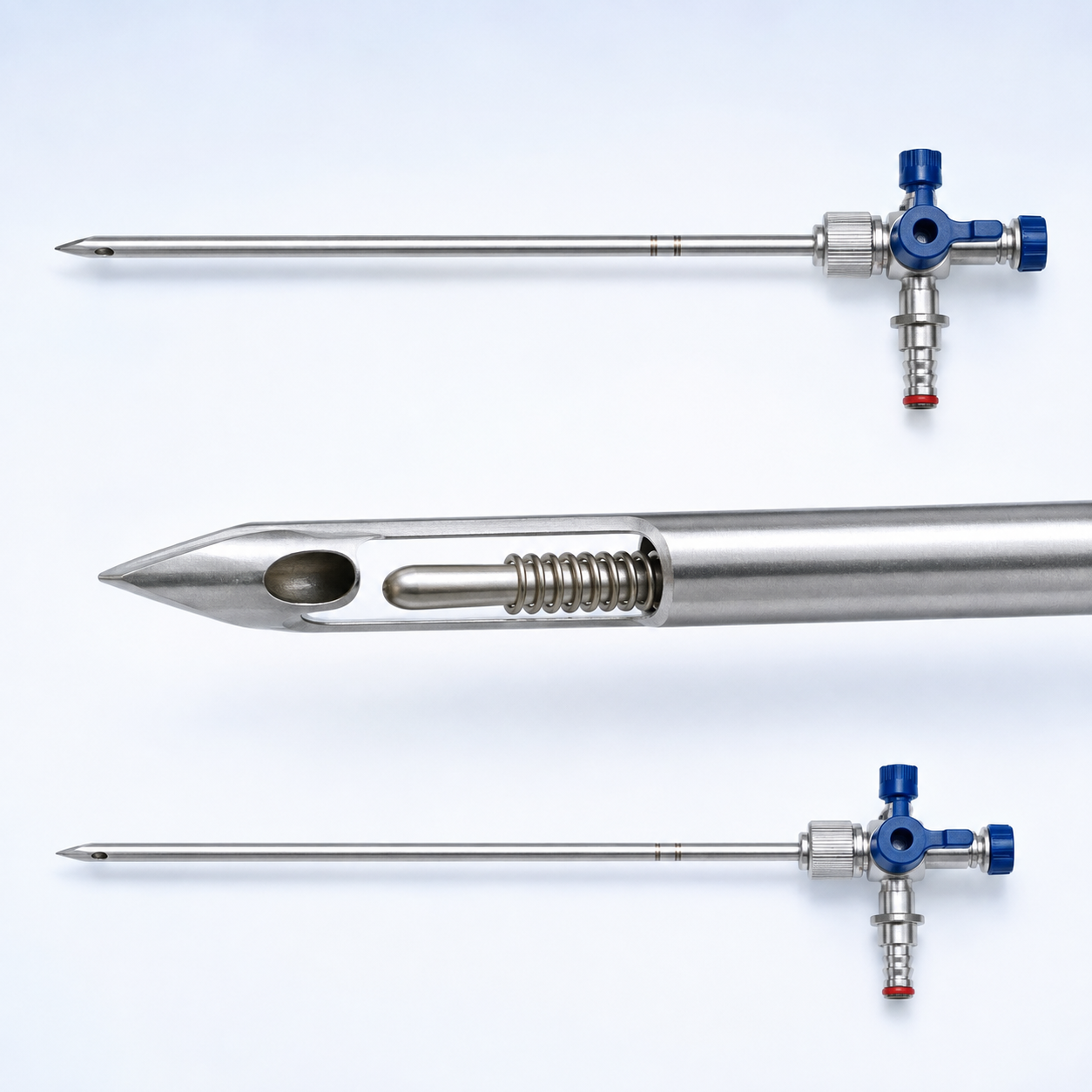
Gynecology Instruments surgical instrument on a clean clinical blue background
Quick Answer

Quick Q&A: Veress Needle Essentials

Question Answer
What is a Veress needle used for?Establishing pneumoperitoneum before selected laparoscopic procedures
What gas is normally used?Medical-grade carbon dioxide with a compatible insufflator
Does it create an operating port?No; a trocar and cannula are used to create the port
What is inside the needle?Typically a spring-loaded blunt stylet
Is it reusable?Reusable and disposable versions are available
Is it always supplied sterile?No; check the exact product label
Are different lengths available?Yes, to suit different access and anatomical requirements
Is it the only laparoscopic entry method?No; open, direct trocar and optical entry methods also exist
Who selects the entry method?The responsible surgeon based on the patient and procedure
Mechanism of Action

What Is Pneumoperitoneum & How Does It Work?

Controlled introduction of gas into the peritoneal cavity creates working space for laparoscopic visualization.

Insufflation System Components

The closed-entry laparoscopic insufflation system may include:

  • CO₂ insufflator • Medical-grade carbon dioxide supply
  • Insufflation tubing • Filter, when required
  • Veress needle • Stopcock or flow-control component
  • Pressure and flow monitoring
  • Trocar and cannula system

The Veress needle acts as the initial access and gas pathway. A trocar and cannula are placed separately after pneumoperitoneum is established.

What Does the Spring-Loaded Stylet Do?

The spring-loaded blunt inner stylet is designed to:

  • Retract when the distal end meets resistance
  • Expose the sharp outer cannula during tissue passage
  • Extend forward when resistance decreases
  • Cover the sharp tip immediately upon entry into the cavity
  • Permit gas flow through distal lateral openings

This mechanism must move freely. The spring-loaded stylet is a safety feature but cannot eliminate the risk of organ or vascular injury.

Anatomy of a Needle

How Is a Veress Needle Constructed?

Distal Assembly

Sharp outer cannula:

Provides the penetrating component. Its condition, straightness and distal profile are critical for safe entry.

Insufflation opening:

Gas passes through the needle lumen and exits through one or more lateral openings near the distal end of the stylet.

Proximal Assembly

Luer-lock connector & stopcock:

A proximal Luer-lock or specific connector allows attachment to insufflation tubing. Integrated stopcocks help control the gas pathway.

Handle or hub:

The proximal body provides a holding surface and may contain the spring mechanism or a position indicator for the stylet.

Entry Methods

Veress Needle vs Trocar & Entry Methods

Veress Needle vs Laparoscopic Trocar

These are distinct products performing different functions in laparoscopic access:

  • Veress needle: Used for initial insufflation to establish pneumoperitoneum. Has a narrow diameter and is not intended as a working channel.
  • Laparoscopic trocar: Used to create and maintain the instrument-access port. Has a larger diameter matching the telescope or surgical instruments.

A Veress needle should not be described or ordered as a trocar.

Entry Method Comparisons

Veress-needle entry (Closed technique):

Pneumoperitoneum is established using the needle before placement of the first trocar.

Open entry (Hasson technique):

Involves a surgically created opening followed by placement of a blunt cannula or Hasson-type trocar.

Optical & Direct entry:

Optical trocars allow visualization of tissue layers during access. Direct trocar entry introduces the trocar without first creating pneumoperitoneum.

Procurement Specs

Lengths, Gauges and Reusable vs Disposable

Needle Length and Diameter

Common working lengths:

Veress needles are available in lengths such as approximately 7 cm, 10 cm, 12 cm, 13 cm, and 15 cm. Sizing depends on patient anatomy, abdominal-wall thickness, access location and procedure type.

Diameter & Gauge:

Common commercial models are approximately 2.1 mm in diameter or 14-gauge. Ensure every supplier quotes against the same measurement parameters.

Reusable vs Disposable Veress Needles

Reusable Veress needle:

Suitable for repeated use in high-volume facilities. Requires validated reprocessing, internal lumen cleaning, stopcock maintenance and spring/tip inspection.

Disposable Veress needle:

Supplied sterile and preassembled for one-time use. Involves continuous purchasing, inventory management, storage and packaging checks.

Do not reprocess a single-use Veress needle. Reusable needles require CSSD capacity to clean the internal lumen.

Quality Control

Safety Risks & Pre-Use Inspection

Complications & Risks

Potential complications associated with initial laparoscopic access and insufflation include:

  • Bowel, organ or vascular injury
  • Abdominal-wall injury or bleeding
  • Preperitoneal or incorrect gas placement
  • Gas-related complications or failed access

Previous surgery, adhesions, pregnancy, or body habitus affect the choice of access technique. The choice belongs to the operating surgeon.

Pre-Use Inspection Checklist

For reusable Veress needles, verify:

Cleanliness • Lumen patency • Straightness • Outer tip sharpness • Blunt stylet spring return • Distal gas openings • Luer connector • Stopcock • Loose parts • Corrosion or pitting.

For sterile single-use needles, verify:

Package integrity • Expiry date • Sterility status • Correct size • Valve or balloon integrity according to product instructions.

Reprocessing Reusable Veress Needles

Veress needles contain narrow internal lumens. Follow the manufacturer's validated instructions for:

  • Point-of-use handling and safe transport
  • Lumen flushing and brushing with an approved size
  • Cleaning, rinsing, drying and visual/functional testing
  • Sterilization (undocumented cycles are prohibited)

The internal lumen must not be assumed clean because the outer surface appears clean.

Veress Needles for Medical Colleges

Training laboratories and simulation centers require needles for access demonstration, endo-trainer exercises, and teaching reprocessing inspection. Training sets must be clearly separated from clinical inventory and marked accordingly.

Manufacturing Excellence

Veress Needles from Bharat Surgical

Bharat Surgical supplies Veress needles and related laparoscopic-access instruments for hospitals, clinics, surgeons, medical colleges, dealers and distributors.

Exact sizes, connectors, sterility and configuration must be confirmed before quoting.

ISO 13485:2016 Certified Quality Management System
ISO Registration Number: RQMD91/11579 (Expiry: 11 Sept 2027)

CE Certificate No. 9277
Scope: Manufacture of laparoscopy, urology, ophthalmic, gynecology, neuro, ENT, orthopaedic and general surgery instruments. (Expiry: 15 April 2028)

GSTIN: 27ADFPA5321C1ZA (Maharashtra)

Buyer’s RFQ Checklist

Include the following in your enquiry:

  • Hospital, clinic or company name • Delivery PIN code
  • Required length • Required diameter or gauge
  • Reusable or disposable preference
  • Sterile or non-sterile requirement
  • Spring-loaded blunt stylet • Connector type
  • Stopcock requirement • Insufflator make and model
  • Insufflation tubing type • Required quantity
  • Pack size • Documentation requirement
  • Sample or evaluation requirement
  • Target delivery date
Got Questions?

Frequently Asked Questions

Quick answers to common questions about Veress needles and laparoscopic insufflation access.

It is used to introduce insufflation gas into the abdominal cavity to establish pneumoperitoneum before selected laparoscopic procedures.

No. It creates pneumoperitoneum. A trocar and cannula are used separately to create the instrument-access port.

Medical-grade carbon dioxide is commonly used with a compatible laparoscopic insufflator.

The spring-loaded blunt stylet extends over the sharp outer tip after resistance decreases. It is a safety-related feature but cannot eliminate access injuries.

It normally has a sharp outer cannula surrounding a spring-loaded blunt inner stylet.

Lengths such as approximately 7 cm, 10 cm, 12 cm, 13 cm and 15 cm may be available, depending on the manufacturer.

There is no universal standard for every patient or system. Approximately 10–15 cm models are commonly available.

The surgeon selects the length according to anatomy, abdominal-wall thickness, access location, procedure and product instructions.

Commercial models may be approximately 2.1 mm or described as 14 gauge, but the exact specification varies.

Reusable and disposable models are available. Follow the exact product label.

Not always. Many reusable models are supplied non-sterile and require approved processing before use.

It should not be reused. Follow its single-use labeling and applicable hospital and regulatory requirements.

A Veress needle introduces insufflation gas. A trocar and cannula create and maintain a port for the telescope or surgical instruments.

Veress entry is a closed technique used to establish pneumoperitoneum. Hasson entry is an open surgical-access technique using a cannula.

No method is universally safest. The surgeon must select the technique based on patient factors, procedure, experience and equipment.

A compatible insufflation tube normally attaches through a Luer-lock or another specified connector.

Inspect cleanliness, lumen patency, shaft straightness, tip, stylet movement, spring return, connector and stopcock according to the product instructions.

No. A needle with a blocked lumen, damaged tip or unreliable spring mechanism should be removed from use.

Bharat Surgical supplies available Veress needles and related laparoscopic-access instruments. Confirm the required size and configuration during enquiry.

Provide the required length, diameter or gauge, reusable or disposable preference, sterility, connector, insufflator model, quantity and delivery location.

Request a Veress Needle Quotation

Send Bharat Surgical the required length, diameter, reusable or disposable preference, connector, and quantity.