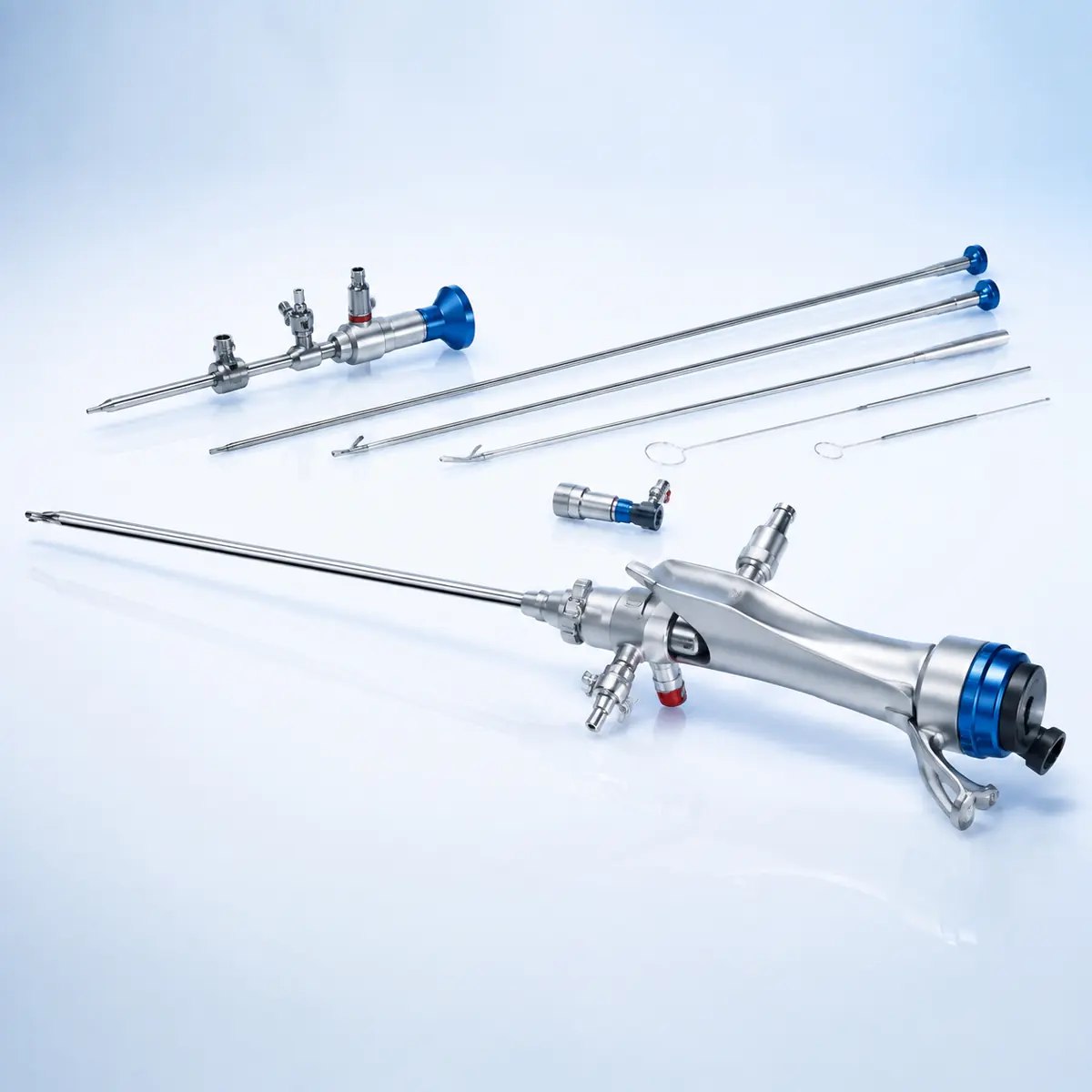
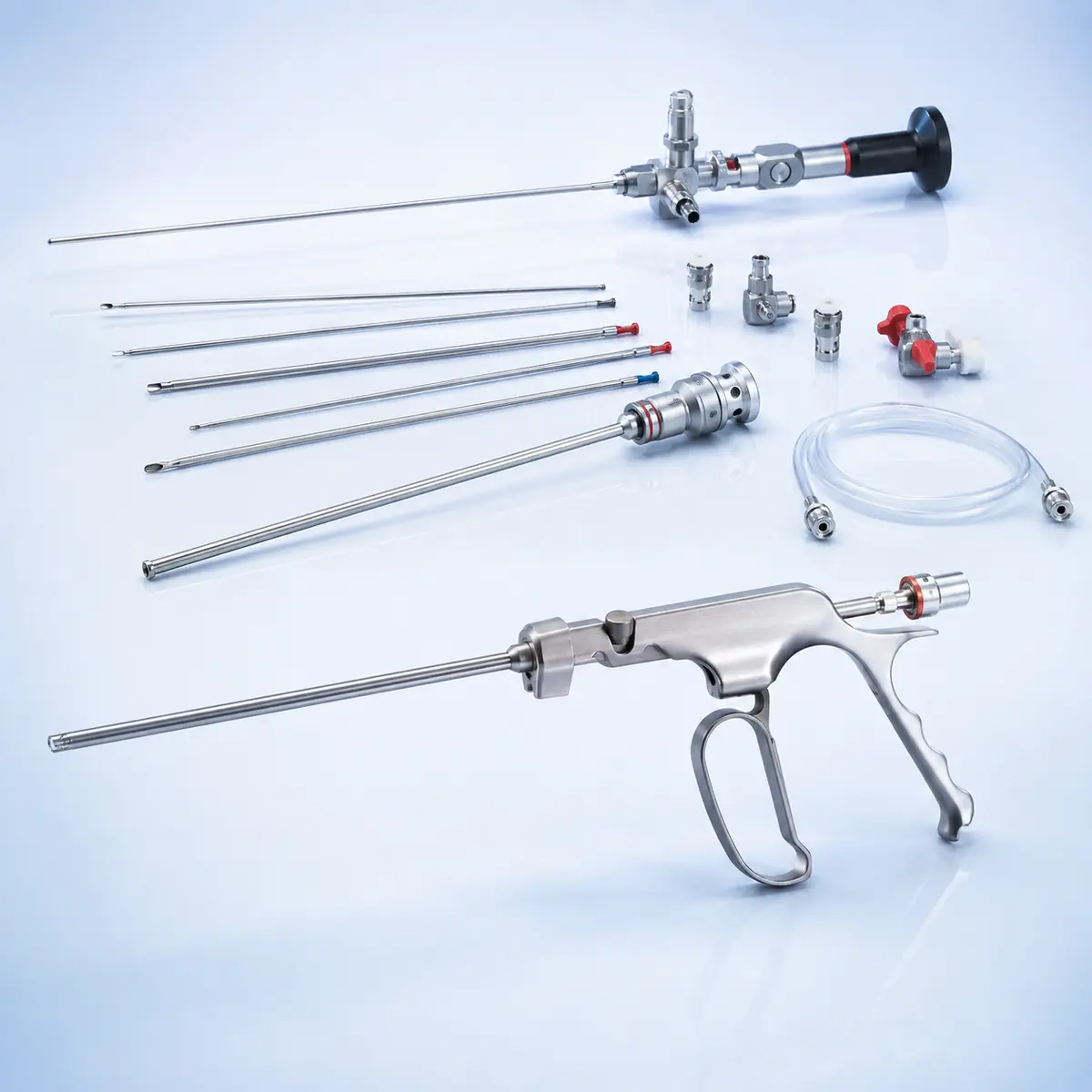
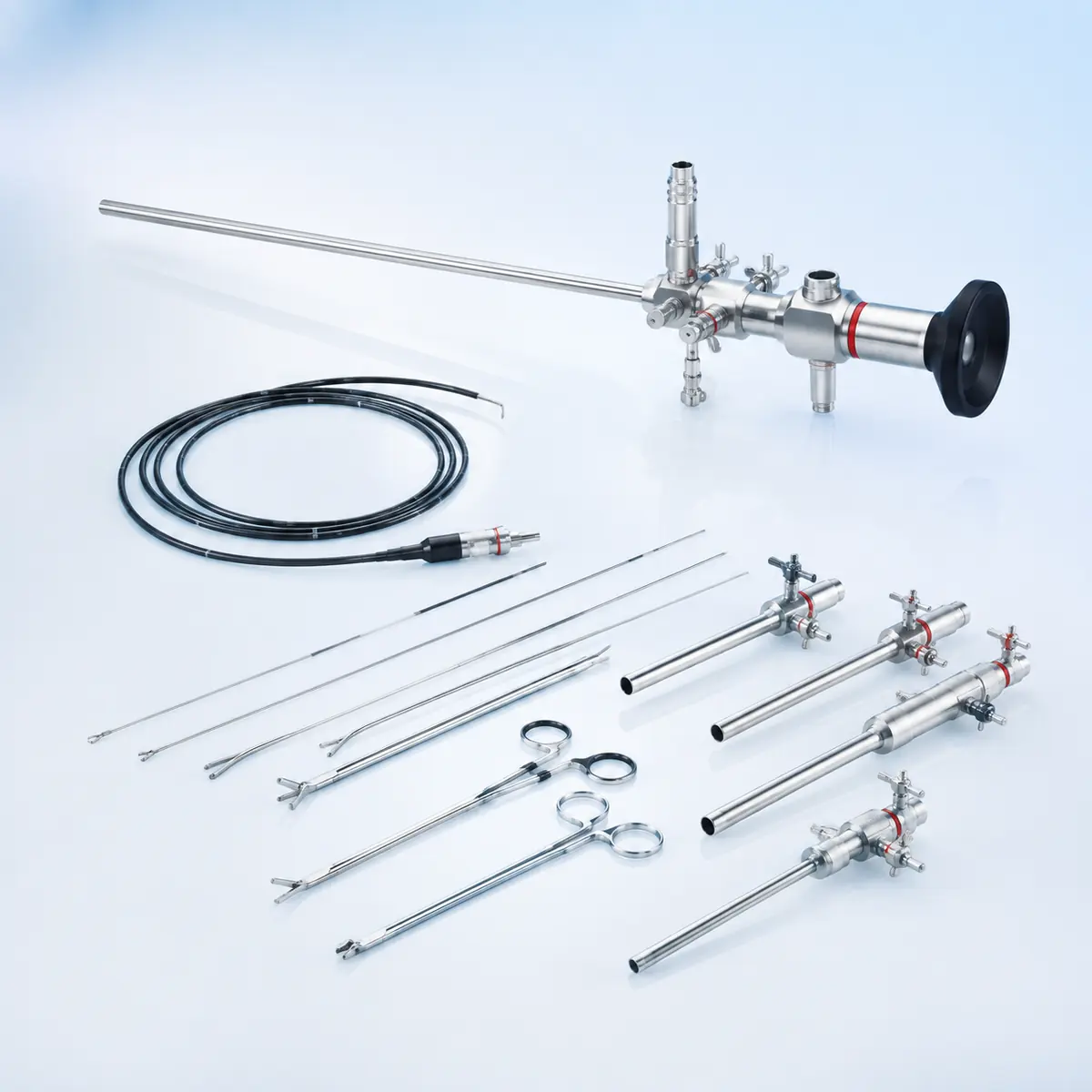
Bharat Surgical offers ureteroscopy instruments and compatible endourology accessories for hospitals, urology departments, surgical centres, medical-equipment dealers and international distributors. The range supports institutional requirements involving visualisation, access, stone management, retrieval and irrigation during compatible ureteroscopy procedures. A ureteroscopy setup combines instruments from different product categories. The ureteroscope, access components, working instruments, guidewires, baskets, forceps, laser fibres and irrigation accessories must be selected as one compatible system. Bharat Surgical therefore recommends technical verification against the exact equipment model before confirming an order.
Ureteroscopy instruments are specialised devices used by trained urologists to examine and treat selected conditions affecting the ureter and kidney through an endoscopic approach.
Depending on the procedure and equipment platform, the setup may include:
Not every product listed above is necessarily manufactured or stocked by Bharat Surgical. Buyers should confirm the currently available range, brand, sterile status and specifications through the final written quotation.
The ureteroscope, access components, working instruments, guidewires, baskets, forceps, laser fibres and irrigation accessories must be selected as one compatible system.
The handle transfers the surgeon’s hand movement to a long, slender insert or shaft, allowing a compatible distal jaw or prong assembly to open, close, deploy or retract during an endourological procedure.
Read More
The URS Push Handle from Bharat Surgical is a manual actuation component designed for compatible ureterorenoscopy forceps, prong graspers and retrieval instruments.
Read MoreRigid Ureteroscope: A rigid ureteroscope has a non-flexible shaft. Procurement specifications may include shaft diameter, working length, viewing angle, working channel, irrigation arrangement and optical interface.
Semi-Rigid Ureteroscope: A semi-rigid ureteroscope provides limited shaft flexibility while retaining a defined working profile. The buyer should confirm the exact diameter at the tip and shaft, working-channel size, length and compatible instruments.
Flexible Ureteroscope: A flexible ureteroscope is designed with an actively deflectable distal section. Important procurement details include insertion-tube diameter, working-channel diameter, deflection specification, working length, visualisation platform and compatible accessories. Flexible ureteroscopes may be reusable or supplied as sterile single-use devices. Reusable and single-use models have different procurement, storage, handling and reprocessing requirements.
Digital and Fibre-Optic Ureteroscopes: A digital ureteroscope may connect to a dedicated image-processing platform, while a fibre-optic model commonly requires a compatible camera, coupler and light source. These systems are not automatically interchangeable.
Guidewires: Guidewires vary by diameter, length, tip design, stiffness, coating and intended use. They are commonly supplied sterile and single-use, but the product label must be checked.
Ureteral Access Sheaths: An access sheath may be selected according to inner and outer French size, working length, dilator design, guidewire compatibility and ureteroscope diameter. The scope must fit the sheath’s usable internal diameter—not merely its outer French size.
Stone Retrieval Baskets: Stone baskets are available in different wire patterns, diameters, lengths and opening configurations. Basket selection depends on the working channel, stone-management requirement and manufacturer-approved use.
Stone Grasping Forceps: Stone forceps may have different jaw profiles and shaft dimensions. Jaw opening, shaft diameter and working length must match the selected ureteroscope and clinical requirement.
Biopsy Forceps: A compatible biopsy forceps may be required in selected diagnostic or therapeutic configurations. Working-channel fit, cup design, length and intended use require confirmation.
Laser Fibres: Laser fibres must be approved for the selected laser platform and compatible with the ureteroscope working channel. Fibre diameter, connector, minimum bending restrictions, power limits and single-use or reusable status must be verified from the manufacturer’s instructions.
Lithotripsy Probes: Pneumatic, ultrasonic or other lithotripsy probes are platform-specific. Generator model, handpiece, probe diameter, probe length and working-channel compatibility must all be confirmed.
Irrigation Accessories: Irrigation accessories may include connectors, tubing, pumps, pressure-control devices or manual systems. Their compatibility and permitted operating limits depend on the scope and irrigation system.
| Component | Information required before ordering |
|---|---|
| Ureteroscope | Brand, model, rigid/semi-rigid/flexible type, diameter and length |
| Working channel | Usable internal diameter and compatible instrument size |
| Camera system | Camera-head model, coupler and eyepiece interface |
| Light cable | Scope connector, light-source connector and cable diameter |
| Guidewire | Diameter, length, tip, stiffness, coating and sterile status |
| Access sheath | Inner/outer French size, usable length and scope compatibility |
| Stone basket | Diameter, working length, basket pattern and channel requirement |
| Stone forceps | Shaft diameter, working length, jaw profile and opening |
| Biopsy forceps | Diameter, length, cup design and scope compatibility |
| Laser fibre | Laser model, connector, fibre diameter and permitted settings |
| Lithotripsy probe | Generator, handpiece, probe diameter and working length |
| Irrigation system | Connector, tubing, pump and permitted pressure or flow |
| Ureteral stent | French size, length, material, configuration and sterile status |
| Instrument tray | Contents, dimensions and reprocessing suitability |
Compatibility warning: Similar appearance, nominal size or descriptions such as “standard,” “Storz type” or “compatible type” do not independently prove interoperability.
| Requirement | Rigid or semi-rigid setup | Flexible setup |
|---|---|---|
| Scope construction | Fixed or limited-flexibility shaft | Actively deflectable distal section |
| Instrument selection | Based on rigid-scope channel and length | Based on flexible-scope channel and deflection limits |
| Working instruments | Appropriate forceps, probes or baskets | Flexible baskets, fibres and channel-compatible devices |
| Visualisation | Optical or digital, depending on model | Fibre-optic or digital, depending on model |
| Reprocessing | Follow the exact reusable-scope IFU | Requires particular attention to channels and delicate deflection components |
| Single-use option | Available for selected products | Available for selected complete scopes and accessories |
| Compatibility | Model-specific | Model-specific and affected by channel and bending requirements |
The clinical team should decide which type of ureteroscope is appropriate. Procurement teams should use that decision to build the correct instrument BOQ.
A ureteroscopy configuration frequently contains both reusable and single-use devices.
Reusable Components: Depending on the model and labelling, reusable products may include:
These products require validated cleaning, inspection and sterilisation or disinfection according to their individual instructions.
Sterile Single-Use Components: Depending on the manufacturer, single-use products may include:
Do not reprocess or reuse a product contrary to its label. Sterile packaging must be inspected before use, and a product should not be used if the packaging is open, wet, damaged or beyond its stated expiry date.
Before requesting a quotation, confirm:
The working channel determines which basket, forceps, laser fibre or probe can pass through the ureteroscope. The nominal diameter of an accessory should not consume the complete working-channel space without considering:
A device that fits through a straight scope may behave differently when a flexible scope is deflected. Follow the ureteroscope and accessory manufacturers’ compatibility information.
Ureteral access sheaths, stents and some endourology accessories are commonly described in French size. As a nominal conversion:
Diameter in millimetres ≈ French size ÷ 3
For example, 12 Fr corresponds nominally to approximately 4 mm. This formula supports initial comparison but does not confirm fit because inner diameter, outer diameter, wall thickness, length and tolerances can vary. When specifying an access sheath, record both its inner and outer French measurements wherever the manufacturer provides them.
Before use, trained personnel should inspect applicable components for:
Remove any questionable instrument from service. Do not attempt to compensate for a damaged or incompatible component during use.
Reusable ureteroscopes and working instruments can have narrow lumens, optical components, seals and delicate moving parts. Reprocessing must follow the validated instructions supplied for the exact product.
The FDA describes reusable-device reprocessing as a detailed, multistep process involving cleaning followed by disinfection or sterilisation. It also notes that complex device designs can be more difficult to reprocess. See the FDA’s reusable medical-device reprocessing information and its reprocessing validation and labelling guidance.
General controls include:
Do not assign one steam cycle, chemical concentration or exposure time to the entire ureteroscopy category. A rigid metal instrument, flexible endoscope, optical component and polymer accessory may have different processing limitations.
| BOQ item | Specification to include | Quantity |
|---|---|---|
| Rigid/semi-rigid ureteroscope | Diameter, length, angle and channel | ___ |
| Flexible ureteroscope | Diameter, length, channel and platform | ___ |
| Camera coupler | Camera and scope interface | ___ |
| Light cable | Scope-side and source-side connectors | ___ |
| Guidewire | Diameter, length, tip and coating | ___ |
| Access sheath | Inner/outer Fr size and usable length | ___ |
| Dilator | Size, length and guidewire compatibility | ___ |
| Stone basket | Diameter, length and basket design | ___ |
| Stone grasping forceps | Diameter, length and jaw design | ___ |
| Biopsy forceps | Diameter, length and cup design | ___ |
| Laser fibre | Laser model, fibre diameter and connector | ___ |
| Lithotripsy probe | Generator, handpiece, diameter and length | ___ |
| Irrigation connector | Scope and tubing interface | ___ |
| Ureteral stent | Fr size, length, material and configuration | ___ |
| Stent pusher | Stent and guidewire compatibility | ___ |
| Instrument tray | Required contents and dimensions | ___ |
| Spare accessories | Exact product or reference number | ___ |
The urologist and biomedical team should approve the final configuration before purchase.
Hospitals may request:
Where the original part number is unavailable, send clear images of the equipment markings, distal end, working ports and connectors along with measured dimensions.
Bharat Surgical accepts B2B enquiries from medical-equipment dealers and distributors. Depending on the product and order, support may include:
Dealer prices, territory availability, private labelling and commercial terms should be confirmed directly.
International buyers should specify:
The importer must confirm whether each device can legally be imported, registered and supplied in the destination country.
All final claims concerning product availability, certification, material, compatibility, sterility, warranty and delivery must follow Bharat Surgical’s current written quotation.
Please provide:
Technical, compatibility, ordering and reprocessing answers for the Bharat Surgical Ureteroscopy Instruments range.
They are specialised endourology devices used with a compatible ureteroscope for visualisation, access, stone management, retrieval and related urological requirements.
Bharat Surgical accepts enquiries for ureteroscopy-related instruments and compatible urology accessories. The current range should be confirmed before ordering.
A set can be discussed according to the ureteroscope type, working channel, stone-management platform and required accessories.
No. Their scopes, working channels, accessory flexibility, lengths and compatibility requirements differ.
It is an endoscope with a fixed shaft. Its diameter, length, working channel and optical interface determine which accessories can be used.
It has limited shaft flexibility while maintaining a defined working profile. The exact design varies by manufacturer and model.
It is an endoscope with an actively deflectable distal section designed for compatible endourology applications.
Some are reusable and others are sterile single-use devices. Check the exact model’s label and IFU.
No. Diameter, length, flexibility, connector and working-channel requirements differ between systems.
It is the internal passage through which compatible devices such as baskets, forceps, probes or laser fibres may be introduced.
Confirm the basket diameter, working length, design, scope channel and manufacturer-approved application.
Provide the shaft diameter, working length, jaw pattern and ureteroscope brand and model.
Bharat Surgical publishes an Optical Stone Crushing Forcep with standard sizing and SS 304/brass listed as materials. Exact compatibility requires confirmation.
No. The optical system, sheath, diameter, length and locking arrangement must be matched.
No. A stone punch set is a separate product category and should not automatically be treated as a ureteroscopy instrument set.
It is an access component specified by its inner and outer size, usable length and compatible ureteroscope diameter.
Not necessarily. The scope must fit the sheath’s usable inner diameter. Outer French size alone cannot establish compatibility.
French size is a nominal diameter measurement. Approximately 3 Fr equals 1 mm.
Many guidewires are sterile single-use products. Follow the exact product label rather than assuming reusable status.
Specify diameter, length, tip design, stiffness, coating, sterile status and intended compatible devices.
No. Laser fibres must be approved for the exact laser platform, connector and intended operating conditions.
No. The fibre diameter, channel size, scope deflection and manufacturer restrictions must be considered together.
No. They must match the generator, handpiece, working channel, diameter and length.
Use limitations depend on the scope and accessory instructions. Physical fit in a straight channel does not confirm suitability during deflection.
Some products may be sterile and single-use, while reusable instruments may be supplied non-sterile. Confirm each line item.
No. A sterile product should not be used if package integrity is compromised.
Do not reprocess a single-use device contrary to its labelling and applicable regulatory requirements.
Use the product-specific validated instructions for point-of-use care, disassembly, brushing, flushing, rinsing, drying and inspection.
No. Optical devices, flexible scopes, seals and other components may have different processing limitations.
Leak testing is a product-specific inspection applied to certain flexible endoscopes before immersion or further processing. Follow the scope manufacturer’s instructions.
Check identification, cleanliness, optical performance, insertion-tube condition, channel patency, connections and function according to the IFU.
Remove it from service. Do not use an accessory with damaged wires, jaws, shafts, handles or operating mechanisms.
Photographs help, but the scope model, dimensions, working channel and original reference details are also required.
Yes, subject to product availability and successful matching with the existing system.
Yes. The BOQ can be developed around the department’s approved scope, equipment platform and accessory requirements.
Dealers and distributors can request quantity-based pricing. Commercial terms depend on the product, volume and destination.
Export enquiries may be accepted subject to product availability, documentation and destination-country requirements.
Send an itemised requirement with equipment models, specifications, quantities and delivery location for a current quotation.
Medical and Procurement Disclaimer: Ureteroscopy instruments are intended for appropriately trained healthcare professionals working within an approved clinical environment. This page provides general product and procurement information. It is not a procedural guide and does not replace clinical judgement, professional training, institutional protocols or product-specific instructions. Product availability, dimensions, materials, sterile status, reusable status, compatibility, packaging, certification and intended use may vary by model. Confirm every specification through Bharat Surgical’s current written quotation, product label and supplied instructions before purchase or use.
Prices depend on ureteroscope type and configuration, optical or digital platform, instrument diameter and length, jaw or basket design, reusable or single-use status, sterile packaging, laser or lithotripsy compatibility, access-sheath size, material and construction, individual instrument or complete set, order quantity, instrument tray, documentation requirements, domestic or export packing, and delivery location. A reliable quotation requires an itemised BOQ. “Complete ureteroscopy set” is not a sufficient specification because requirements differ between rigid, semi-rigid and flexible systems.