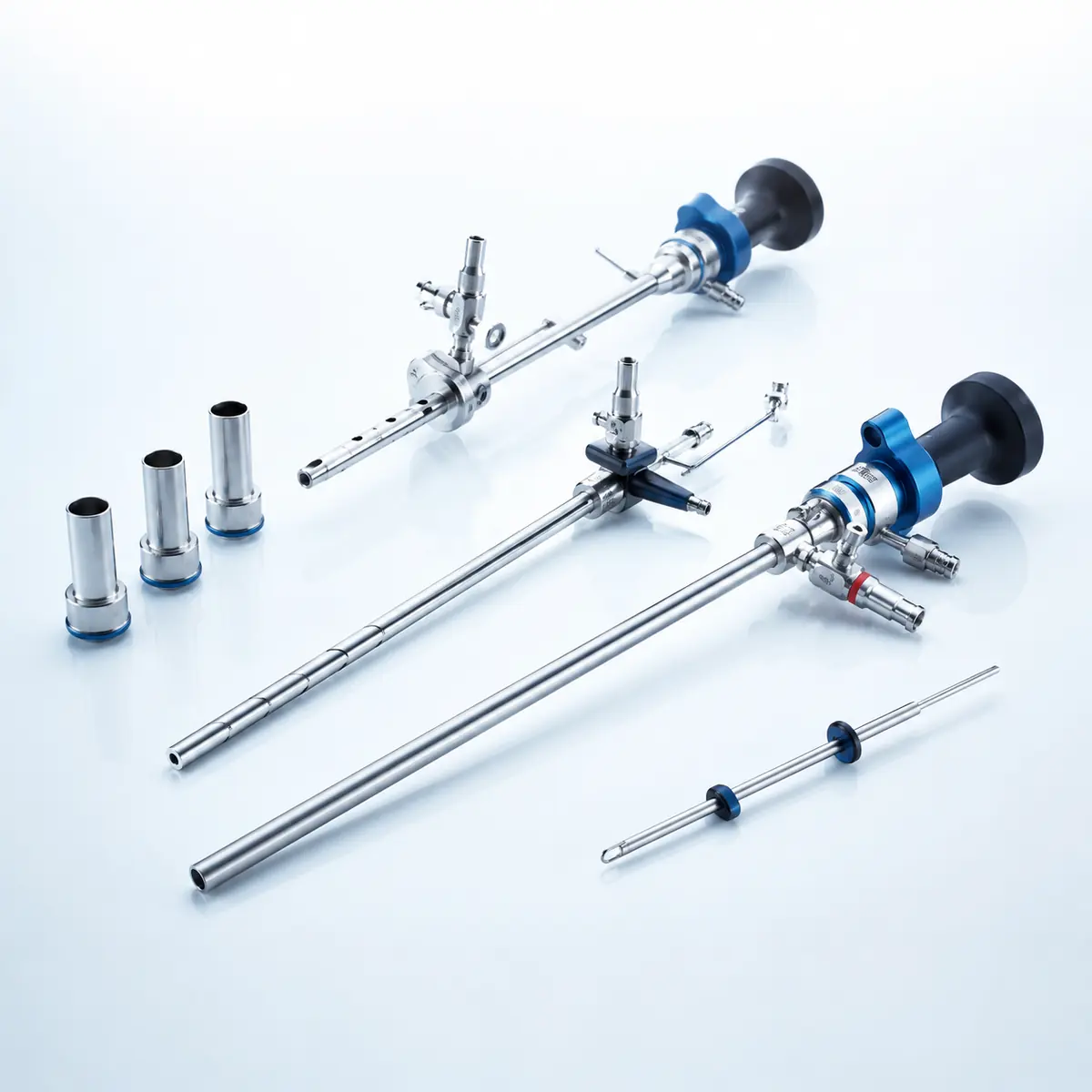
Protect valuable rigid laparoscopes during handling, transportation and approved reprocessing workflows with laparoscope protection tubes from Bharat Surgical. These protective accessories are designed to help reduce unintended mechanical contact with the delicate telescope shaft and optical tip. Hospitals, surgical centres, sterile processing departments, distributors and medical-equipment suppliers can request protection tubes according to the diameter and working length of their rigid laparoscopes. Product dimensions, material, locking arrangement and reprocessing compatibility must be confirmed before ordering.
“Laparoscope protection tube” is not used consistently across the medical-device market. Depending on the manufacturer, it may refer to:
A laparoscope protection tube is an accessory designed to shield part or all of a rigid laparoscope from accidental mechanical contact during approved stages of handling, transportation, storage or reprocessing.
Rigid laparoscopes contain precision optical components. A suitable protection tube may help reduce direct impact, rubbing, bending pressure and contact with heavier instruments when the scope is being moved or arranged in an instrument tray.
A rigid laparoscope may be exposed to mechanical stress when it is:
Stress during transport between operating room and clean utility.
Impact and rubbing during assembly of surgical instrument trays.
Pressure and contact with heavy surgical instrumentation in cabinets.
Physical shifts when loading trays into autoclaves or plasma sterilizers.
Shock, vibrations, and packaging pressures when sent for calibration.
Stress during manual scrubbing, inspection, and high-level disinfection.
Manufacturer instructions for rigid endoscopes warn against bending, twisting and levering forces. They also recommend inspection for deformation, dents, burrs, cracks, sharp edges and deterioration of optical surfaces before use. See the RUDOLF Medical instructions for rigid and semi-rigid endoscopes.
Subject to confirmation of the selected model’s instructions for use, laparoscope protection tubes may be considered for:
The selected tube must not obstruct cleaning, sterilant contact, drying or visual inspection.
The final product table should be populated only after Bharat Surgical verifies the available catalogue models.
| Selection parameter | Information to confirm | |
|---|---|---|
| Compatible telescope type | Rigid laparoscope or specified rigid endoscope | |
| Compatible shaft diameter | Exact telescope outer diameter | |
| Telescope working length | Exact shaft or overall length, as applicable | |
| Protection tube internal diameter | Must provide the intended fit without damaging the scope | |
| Protection tube usable length | Must protect the required section without contacting the optics improperly | |
| Construction material | Stainless steel, polymer or other verified material | |
| Design | Rigid, semi-rigid, ventilated or perforated | |
| Distal-end protection | Open, capped, guarded or otherwise configured | |
| Proximal retention | Friction fit, cap, connector, locking mechanism or tray fixation | |
| Reusability | Reusable or single-use | |
| Supply condition | Sterile or non-sterile | |
| Reprocessing compatibility | Only the methods validated in the product IFU | |
| Packaging | Individual piece, set or tray-compatible configuration | |
| Product code | Bharat Surgical catalogue reference |
Use the manufacturer-stated outer diameter of the laparoscope. Do not select a tube only by describing the scope as “5 mm” or “10 mm” if the exact product specifications are available. The internal clearance must be sufficient for safe insertion and removal without allowing excessive movement.
Share the telescope’s working length and, when requested, its overall length. A protection tube that is too short may leave the distal shaft exposed. A tube that is too long may interfere with the eyepiece, light-post connector or retention mechanism.
The quotation request should include: Telescope manufacturer Model or catalogue number Nominal diameter Working length Direction of view Eyepiece configuration Light-post position Current tray or sterilization container Direction of view—such as 0° or 30°—does not automatically determine tube compatibility, but it helps identify the exact laparoscope model.
Specify where the protection tube will be used: Clean storage Internal transportation Sterilization tray Steam sterilization Low-temperature sterilization Service transportation Another defined workflow A tube approved only for transport must not automatically be used during sterilization.
The telescope should not move freely enough to strike the inside of the tube. At the same time, the retention method must not compress, scratch or place bending force on the laparoscope shaft. The distal lens should have suitable clearance from caps, guards and other internal surfaces.
Compatibility must be verified for the complete combination of: Protection tube Laparoscope Sterilization packaging Instrument tray or container Cleaning process Sterilizer Selected cycle A third-party protection tube’s sterilization compatibility does not establish compatibility for Bharat Surgical products. Use only Bharat Surgical’s approved instructions for the supplied model.
| Product | Primary function | Is it interchangeable with a protection tube? |
|---|---|---|
| Laparoscope protection tube | Helps shield the rigid telescope during approved handling or reprocessing stages | No |
| Trocar cannula | Provides an access port for laparoscopic instruments | No |
| Telescope operative sheath | Surrounds a telescope in a specified endoscopic system | No |
| Sterile camera drape | Covers compatible camera equipment in the sterile field | No |
| Disposable scope cover | Creates a manufacturer-defined protective covering for a scope | No |
| Sterilization tray | Holds and organizes instruments during an approved cycle | No |
| Transport container | Contains instruments during movement between locations | No |
| Distal-tip protector | Protects only the distal end or lens area | No |
A protection tube surrounds or guards a specific telescope. A sterilization tray supports one or more instruments within a larger container or basket.
Depending on the validated configuration, the two accessories may be used together. However, neither should obstruct sterilant exposure, drainage or drying. The protection tube should be secured so that it cannot roll or collide with heavier instruments inside the tray.
Depending on the selected Bharat Surgical model, relevant features may include:
Before approving a protection tube, the biomedical engineering, operating-room and sterile-processing teams should verify:
Inspect both the protection tube and laparoscope under suitable lighting.
Check the protection tube for:
Check the laparoscope separately for shaft deformation, damaged optical windows, reduced light transmission and image-quality problems according to its manufacturer’s IFU.
Remove a damaged or questionable accessory from service. Do not force a telescope into a tight, bent or damaged tube.
Always follow the model-specific Bharat Surgical IFU. General principles include:
Treat used accessories as contaminated according to the healthcare facility’s policy.
Rigid-endoscope reprocessing instructions can differ by manufacturer. The laparoscope and its protection tube must therefore be assessed as separate devices, each with its own IFU.
Only when the protection tube manufacturer, laparoscope manufacturer and sterilization-system instructions support that configuration.
The tube must not prevent:
If the documentation does not expressly approve assembled sterilization, process the components separately according to their respective instructions.
After approved reprocessing, store the protected laparoscope in a clean, dry and controlled location according to the scope manufacturer’s instructions and hospital policy.
Avoid:
Procurement Notice: A protection tube does not replace the need for an appropriate transport container, sterile barrier or storage system.
Laparoscope protection tubes may be requested by:
Suitability depends on the selected tube and the facility’s established workflow.
A correctly selected protection tube can support:
These are workflow and equipment-protection considerations. They should not be presented as guarantees against scope damage or healthcare-associated infection.
"Item: Laparoscope Protection TubeApplication: Protection of specified rigid laparoscope during approved handling, transport, storage or reprocessing workflowCompatible Scope Diameter: ___ mmCompatible Scope Working Length: ___ mmTube Material: As per approved specificationTube Design: Rigid/semi-rigid; ventilated or non-ventilated as specifiedRetention System: As per compatible configurationReusability: Reusable/single-use, to be specifiedSupply Condition: Sterile/non-sterile, to be specifiedReprocessing Compatibility: Manufacturer-validated method requiredQuantity: ___ piecesDocumentation: Product catalogue, instructions for use and applicable quality documents"
The purchaser should replace every blank with a verified technical requirement before releasing the tender.
Bharat Surgical supports enquiries from medical-device distributors, institutional suppliers and export partners.
Please provide:
Product availability and regulatory status may differ by market. Approval, import and distribution requirements should be confirmed before commercial supply.
Bharat Surgical works with hospitals, healthcare institutions and medical-device distributors seeking laparoscopic instruments and related accessories.
Buyers can contact the team for:
Compatibility should always be confirmed against the exact laparoscope model rather than relying only on nominal diameter.
Explore related product categories:
Internal links should be added after the corresponding website pages are published.
Find technical, reprocessing, ordering, and size compatibility answers for the Bharat Surgical Laparoscope Protection Tubes range.
It is an accessory designed to shield a rigid laparoscope during manufacturer-approved stages of handling, transportation, storage or reprocessing.
Depending on its design, it may protect the laparoscope shaft, distal optical area or both from direct mechanical contact.
No. A trocar provides surgical access, while a protection tube is intended to guard a laparoscope during specified handling or reprocessing activities.
Not necessarily. An operative sheath is part of a defined endoscopic system. A protection tube normally serves an equipment-protection function.
Only if the supplied model is specifically designed, documented and approved for procedural use. A transport or sterilization protector must not automatically be used on a patient.
Reusable and single-use products may both exist. Check the label and IFU supplied with the selected Bharat Surgical model.
The supply condition must be confirmed for the exact model. Do not assume that a new protection tube is sterile.
Availability should be confirmed according to the required laparoscope diameter and length. Share the exact telescope specifications when requesting a quotation.
Potential compatibility depends on the exact telescope diameter, working length and connector arrangement—not only its nominal 5 mm description.
Submit the manufacturer, model number, actual diameter and length so Bharat Surgical can review the required configuration.
The viewing angle alone may not change the tube requirement, but it helps identify the exact telescope model. Compatibility should be checked using complete specifications.
It should protect the intended section of the scope without pressing against the distal lens or interfering with the eyepiece and light connector.
It should provide secure protection without scratching, compressing or placing bending force on the telescope. Follow the specified fit and retention method.
Possibly, but only when the dimensions and mounting arrangement are compatible. Universal compatibility should not be assumed.
Normally, diameter-specific selection is safer. Use only configurations expressly documented for the relevant scope sizes.
Custom availability should be discussed with the sales team. Provide a dimensional drawing or verified scope specifications.
Material depends on the model. The approved product specification should identify whether the tube is stainless steel, polymer or another material.
It is a design with openings intended to permit fluid, air or sterilization media to pass through. Its use during reprocessing still requires manufacturer validation.
Only when the exact assembled configuration is validated. A closed tube could interfere with air removal, sterilant contact or drying.
Only if all applicable manufacturer instructions approve the tube, laparoscope, packaging and selected steam cycle in that configuration.
No. Sterilization compatibility varies. Check the markings and IFU for the exact laparoscope.
Only when the tube and laparoscope are both compatible with the specific sterilizer, cycle and packaging configuration.
No. A tube guards the telescope, while a tray supports and organizes instruments within an approved processing system.
No. Unless specifically validated as such, a protection tube is not a sterile barrier system.
No. It may reduce exposure to certain mechanical contacts, but careful handling, secure tray placement and routine inspection remain necessary.
Use only the cleaning method, detergent, brushes and equipment permitted by the product IFU. Internal surfaces and openings require particular attention.
Follow the manufacturer’s instructions. Detachable or connected parts may need to be separated so all surfaces can be cleaned and inspected.
Look for dents, cracks, burrs, corrosion, blocked openings, loose components, retained soil, moisture and changes in fit.
Remove it if it is damaged, difficult to clean, deformed, corroded, loose, rough or no longer holds the telescope as intended.
Do not straighten or repair it locally unless an authorized service process exists. A distorted tube may damage the laparoscope.
Avoid metal brushes and abrasive materials unless the manufacturer expressly permits them, as they may scratch surfaces and promote corrosion.
Only within an approved arrangement that prevents movement and contact with heavier or sharp instruments.
It must be placed within an appropriate, identified transport system according to hospital policy. A protection tube alone may not provide adequate containment.
Sample availability depends on the model, quantity and destination. Share the exact laparoscope specifications when making the request.
Provide the telescope brand, model, diameter, working length, intended use, sterilization method, required quantity and delivery destination.
Bharat Surgical can receive institutional, distributor, dealer and export enquiries, subject to product availability and applicable market requirements.
The price of a laparoscope protection tube depends on: For an accurate quotation, share the laparoscope manufacturer, model, diameter, length, intended workflow and required quantity.
Factors Affecting Price: Construction material, Compatible scope diameter, Required length, Rigid or flexible design, Ventilation or perforation pattern, Distal-end protection, Locking or retention mechanism, Reusable or single-use configuration, Sterile or non-sterile supply, Standard or customized dimensions, Quantity ordered, Packaging requirements, Documentation and export requirements, Delivery destination